
Moscow Burning
Ukrainian Drone Wizards are knocking on Putin's door. This is only the beginning of the pain. The longer the occupation continues, the worse it will get for russia.

I really love it when the Ukrainians do something that makes it easy to come up with the headline for a weekly update.
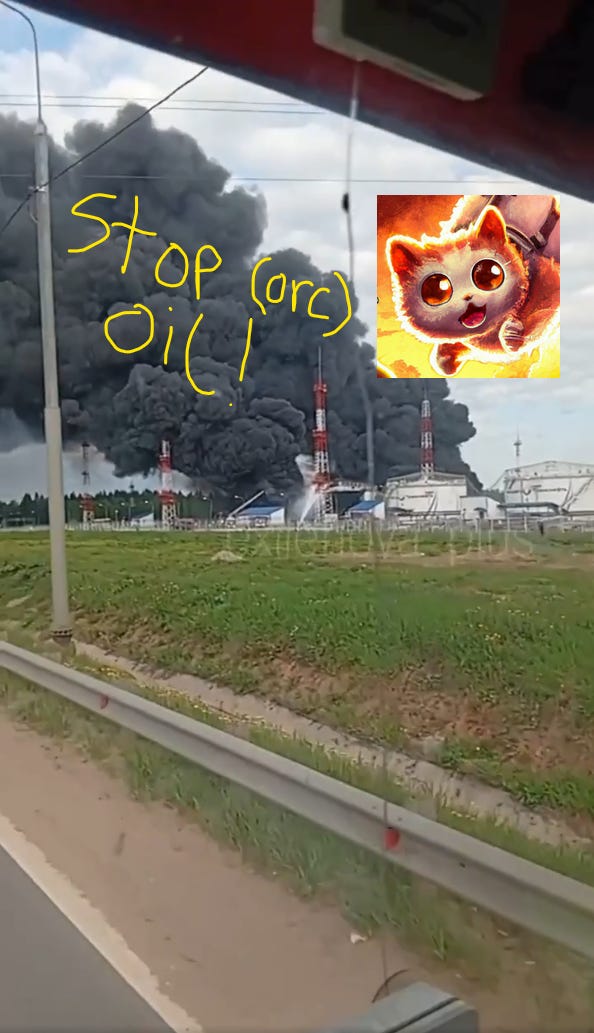
Close to three and a half years and nearly two hundred weekly forecasts in, coming up with a title for a post that isn’t just Ukraine keeps marching down the road to victory - no, really is one of the tougher challenges of this work. Forecasting key developments is much easier than it really ought to be.
Moscow Burning practically writes itself, thanks to the biggest Ukrainian drone attack on the enemy capitol to date. Oil infrastructure and an electronics factory were hit, with civilian footage recording at least one drone circling a Muscovite suburb before diving to strike a target.
Which suggests live operator control via relay or satellite. In the most heavily defended airspace on the planet. Nice.
Disclaimer up front: no, a few drone impacts in Moscow on one night does not mean Putin falls tomorrow. Strategic bombardment can be a powerful tool, but is never decisive alone, and don’t let any historian tell you otherwise. Especially American.
Ukrainian ability to consistently penetrate multiple dense air defense rings around Moscow is still limited: it took hundreds of drones to land several confirmed hits, same as when Moscow does this to Ukraine. The damage inflicted was inherently limited, because while a drone with a shaped-charge warhead can set a fuel refinery or depot ablaze with relative ease, factories are less combustible.
Warehouses sit somewhere in between, depending on what they’re storing at the moment with one blaze badly damaging a Moscow freeway after Ukraine’s strikes. So the Muscovites get even more incontrovertible physical evidence that they’ve vulnerable. But this isn’t the end of the war quite yet, nor is Putin ever going to surrender because of drone strikes alone.
This was a 20% material, 80% symbolic win; yet unlike earlier incidents of a drone hitting downtown Moscow during the war, Ukraine’s bombardment this time was on a level that can’t be written off to luck or a one-off. The Ukrainians just proved that Zelensky’s decree allowing Putin to hold his annual parade was in fact more than trash talk.
Moscow made the correct choice in scaling back the affair, and was issuing threats ahead of it to forestall an attack, because the orcs know the truth: Ukraine now has the ability to successfully disrupt anything within about two thousand kilometers of the border. Hitler could only have dreamed of that capability.
Ironic, then, that Putin claims to have launched his “special military operation” to “denazify” and disarm Ukraine. The nazis in this war are nearly all on Putin’s side (everybody seems to have a few, unfortunately, they’re like a chronic infection) as it is, and Ukraine is better armed now than it has been across the country’s entire history.
Heckuva a job, Vladimir! Between you and Donny boy over in D.C., humanity is getting an object lesson in why anyone with too much power is a threat to everybody, including themselves.
Putin can only sit and review a parade in the heart of the empire for no longer than about an hour without taking a very real risk. Even Trump can still play golf outside sometimes, though he too is increasingly forced to hide indoors.
I’ve been forecasting that this day was coming for years, provided that the Ukrainians took some very logical steps. There have been enough times where a Ukrainian official said or did something perfectly in line with what I’d have recommended myself based on the science I know to be certain that the Ukrainians have a viable plan to win this thing.
Here’s a fun fact that makes me suspect that Zelensky knows exactly what he’s doing. His dad was a mathematician, and one of his specialties was cybernetics. One of the essential foundational fields that built modern systems theory.
I suspect this plays no small role in Zelensky’s effectiveness as a communicator, and why his comedy was so popular. Communication is, after all, a system. Bit more on that in the signals section where I dive a bit into the implications of the AI craze.
As far as his genocidal war goes, either Putin backs off soon and russia gives up the pretension that Ukraine was ever russian, or this war will tear russia apart. The threshold may have already been crossed, like a Chornobyl responder hit with a fatal dose of radiation but organ death hasn’t yet reached the point they feel the horrible effects.
Compounding the Muscovite plight is the fact that Ukrainian drones broke through even after Moscow had moved to massively reinforce Moscow’s defenses, leaving gaps elsewhere. Another huge refinery burned last week, this time in Ryazan, which is just outside the Moscow region. Others were smacked around too.
Downtown Moscow is difficult to bomb, but still not immune, even though the rest of the empire is more exposed than ever. The implications ain’t great for the orcs.
Muscovite fury at this abject humiliation is why the orcs unleashed their own record-breaking two-day revenge onslaught with drones and missiles soon after. But despite sending upward of two thousand weapons at both western Ukraine and Kyiv, killing several dozen civilians, Moscow's counterstrike only did its own part in revealing the empire’s weakness.
Earlier in the war, when Putin got really mad, he’d send over a hundred missiles at Kyiv in a few hours. Now, he’s lucky to manage fifty overnight, more than half air-launched cruise missiles that are knocked out with a nearly 100% success rate. Ground-launched cruise missiles are tougher because they can be fired from closer to the border than orc bombers are willing to fly, cutting reaction times.
Ukraine’s near-complete defeat of the Black Sea Fleet’s Kalibr cruise missile launchers have almost entirely neutralized the salvos of two to three dozen that used to come at Ukraine every week or so. The throw weight of the orc heavy bomber fleet has been at least halved by the covert op last year which used smuggled drones to waste a third or more of Moscow’s active force.
The only weapon that the Ukrainians can’t easily answer are Iskander ballistic missiles, and even these are under increasing pressure thanks to some hits on launchers and Ukrainian attacks on supply chains tied to Iskander production. And soon enough the Ukrainians will be fielding Iskander equivalents of their own.
Too many critical variables are trending in Ukraine’s favor these days for Moscow to withstand the pressure forever. The process has taken longer to pass the tipping point than I hoped, but it’s definitely underway.
Systems have inertia. It’s one reason why they tend to change slowly, then all at once, like a dislodged boulder in an avalanche. Or rather, the system which failed to change quickly enough collapses, and a successor is born from the ashes.
The Ukrainian system has truly adapted to the demands of the Network Age. Moscow’s efforts to adapt have only deepened russia’s dilemma, because their aim was only ever to prop up the system itself, not achieve any concrete external objective.
Muscovite leaders are as stuck as American ones are: their system is falling apart, but even to admit it will logically require actions few if any leaders are prepared for. Because most of them are still in it to advance their careers and nothing more. MAGA, progressives, liberals, conservatives all flip sides of the same trick coin.
Ukraine’s leaders face an actual mortal threat to their lives. That sort of incentive tends to motivate critical thought. American leaders still think an expensive, reinforced White House ballroom will save them from being locked in together until they all starve. They are poorly educated and ignorant. Yet truth is just a few clicks away. Pick the social media feed of a Ukrainian brigade or activist, and the evidence is inescapable.
In a world where everyone is trained to expect instant gratification, any process which takes a while tends to be aggressively doubted. Ukraine’s situation in this regard was, as I still strongly suspect was the outright intention, worsened by the wall-to-wall coverage in early 2023 that treated the upcoming counteroffensive like a TV show bound to end in the swift rout of russian forces thanks to the use of NATO tanks.
Real war is nothing like the stage-managed Hollywood productions that the US Pentagon has structured itself to fight, creating a pernicious feedback loop that encourages US media to portray it that way.
War is much more like construction or cooking than theater. There’s drama of all kinds, comic to tragic and everything in between, but it’s only visible from the inside.
Like a house or meal only comes together in the last phase of construction, Ukraine’s dismantling of the world’s last old-pattern empire is incredibly difficult to perceive until the final stage. The situation is not helped by the incentives driving most foreigner observers who still cover the Ukraine War - and even some domestic types. A fair few are quite happy for the fighting to go on forever.
It won’t, though. Even diehard Muscovites can finally see the end of this thing on the horizon. And that the best they can hope for now is a frozen front. Putin being forced to grasp at ever wilder options like making Belarus finally attack, going for total mobilization, or bombing so-called “decision centers” in Kyiv, is a strong signal of how screwed he is.
You can see in the call to bomb sites allegedly off-limits until now the very same delusion that animates cowardly loons like Lindsay Graham in the USA. Bomb them harder until they submit is the age-old policy prescription of the fool whose con has been exposed. That absurd club of US hacks who have been after the US wiping out Iran since 1979 are a bunch of treasonous scum willing to send other people’s kids to die for their pompous vanity.
Same is true of the orc warbloggers who have in the throes of a collective stroke much of this year. In Ukraine’s case, the only way to actually get at underground leadership bunkers is to nuke them. They’re beyond even US bunker-busters, which couldn’t do more than collapse access tunnels when used on Iranian targets, not wipe out nuclear facilities outright.
All Putin could accomplish by going through with a massive attack on Bankova and the president’s residence is to look even more like a comic book villain than the twit already does. Doing it would reveal the hard limits of his power, which would prove catastrophic for his bluff that that has as much hard power as everyone chooses to believe.
Same holds for a nuclear attack. Nukes are for scaring civilians, not the battlefield. The moment one goes off and the world doesn’t end, all of a sudden the people who believe that any nuclear use equals apocalypse would find new rhetoric. And the reflexive control Putin exerts over his enemies by shaking his nuclear saber would disappear.
Between Moscow’s ability to hold the fronts, endure Ukrainian strikes behind them, prevent the economy from collapsing, manage social discontent stemming from internet disruptions, and keep an eye on any would-be successor hoping to replace him, something is bound to give. A chain reaction is likely to follow. Probably by winter, almost certainly by the summer of 2027.
I’m not writing propaganda here, but forecasting. There is a difference. Propaganda is about selling a storyline. Forecasting aims to identify the range of possible futures. They are mutually opposed.
Contrary to a faddish new idea I’ve seen appearing in western intellectual circles lately, prediction and forecasting in human affairs are not impossible. Much the contrary. Even seemingly random human conversation is provably predictable, within bounds - hence chatbots. Warfare depends on so many testable moving parts that the outcome of most conflicts are deeply predictable.
This nonsense about prediction being impossible is a response to so many of their claims about the Ukraine War - and wider world - constantly being kicked in the groin by reality over the past few years. A portion of the commentator class, particularly historians, are falling back on the cheap postmodernist assertion that nobody can really know anything.
Like, tell a biochemist or meteorologist that they don’t know anything because they can’t nail down every aspect of their field 100%, assholes. Y’know, people whose professions have managed, over the course of a generation, to advance human understanding of some very complex things by leaps and bounds in ways that save actual lives. Unlike anything a postmodern academic ever accomplished. Thank goodness that there are still a few critical realists out there.
The whole point of science, which is what anyone with a PhD is supposed to be qualified to do, is forecasting and prediction. If you’re wrong too often, you need to check your paradigm. This is the process. This is the point. If that hurts anyone’s feelings, I’m not sorry. Some things are too important for anybody’s pride.
A wide range of tenured faculty who hold PhDs will dispute this, but not with the ruthless application of drones, so if push comes to shove, my cultural revolution beats theirs. Or rather, Robert “Magyar” Brovdi, et al’s will, if the guy decides to take over the world.
To hold an idea requires having a working brain, which drone strikes can and will eliminate. At a rate of about a thousand a day, in occupied Ukraine, right now. Anyone who isn’t terrified by the implications isn’t paying attention. Probably a wise move, frankly.
Objectively, scientifically, the Ukraine War is an utter disaster for russia. The russians can no longer win, and at the moment they still have a lot to lose.
Pride and fear prevent Putin from ordering a retreat to defensible lines and a reversion to negotiations. Cowardice and learned helplessness are all that stand between him and a coup.
This weekend in the US state of Idaho, two U.S. Navy EF-18G Growler jets inadvertently aptly illustrated Putin’s situation:
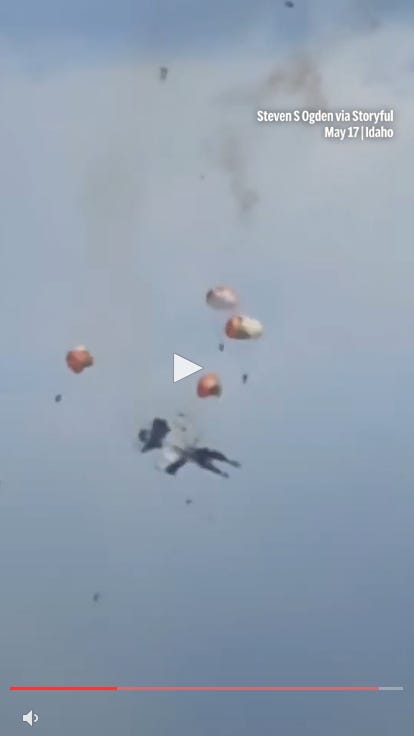
During a maneuver at an airshow near Mountain Home, the rate of closure got too high and the trailing aircraft’s nose hit the tail of the leader. The jets wound up, well, mated, for lack of a better term. Within seconds the crews of both aircraft safely ejected, like, almost simultaneously.
Either they were responding to an order over the radio or both crews knew from the moment of impact they had to bail. They were damn lucky though, because the way those jets were playing leaf on the wind, they could have easily been ejected below the falling aircraft.
Less experienced aviators might have tried to recover and paid the ultimate price. Image doesn’t show it, but the ground was maybe a few hundred meters below. Impact came in seconds after the crews got out. Big kaboom.
Aerodynamics is a funny thing. Aircraft can sometimes do things you wouldn’t think possible and recover. When the jets in the above video hit, they merged into one aerodynamic unit and flopped around like doing an odd little dance. Then straight down they went.
But for a brief moment there, a pilot might have thought they could separate and recover. Say they were afraid of being shamed for bailing out a hundred million dollar electronic warfare jet too soon. They might have even regained a semblance of control before realizing that there was no way to get lift under their wings before impact.
Physics is a real bastard like that. The forces that world leaders play with may be even less intuitive, but they’re just as real.
Putin’s can fire off missiles and drones and order another futile summertime push beyond a killzone that stretches between twenty and thirty kilometers. He can rattle his nuclear saber and go visit Xi to laugh about Trump’s pretensions together.
But he goes as a supplicant, a dependent, a satrap. Not a tsar. Dead leader walking. Wondering every day who plants the first knife.
The consequences of russia’s defeat in the Ukraine War will be profound. Reliable history is hard to come by, but one recurring fact stands out: losing a war triggers upheaval in russia. We’ll see if theory matches up with the evidence in a year or two. But prior cases paint a pretty clear picture of the system we’re dealing with.
State of the Fronts - Week 20 2026
For Moscow, the fighting in 2026 so far has been an unmitigated disaster. Sustained advances have been almost nonexistent, with Ukrainian counterattacks ramping up to reclaim almost as much ground as was lost. The orcs have still suffered upwards of 150,000 dead and seriously wounded for practically nothing.
Ukraine’s casualty rate overall may be down to a tenth of what the enemy suffers, fatalities a smaller fraction still. Moscow is absolutely failing to adapt to Ukraine’s killzone, with the likely result of being forced to transition almost exclusively to defensive operations by autumn.
I can’t forecast urban Donbas falling in 2026. Moscow might, might get Kupiansk, Lyman, and Kostiantynivka before losing any ability to make further forward progress. Possibly a bum rush to the outskirts of Sloviansk and Kramatorsk will make them frontline battlefields before the end. It’s also possible that Orikhiv could fall, maybe.
But Zaporizhzhia, Dobropillya, Kharkiv, Sumy, Kherson, and the bulk of Sloviansk and Kramatosk - risk of occupation is approaching zero. Putin’s war for Donbas has failed. Donetsk and Luhansk cities are both in easy range of Ukrainian middle strike drones. And Ukrainian drone operators have started hunting along the rail and road connections to Crimea from Rostov.
This is what the descent to defeat looks like just after the tipping point is crossed. For a brief time, relative to the event, the wheels are still turning and eyes are still looking to the horizon. Not long now until orcs across the empire look down. Then comes the long fall. Ukrainian territory could extend all the way to the Volga by 2030. Who expected Ukraine to exist as an independent state in a few years back in 1987?
In this insane live-action cartoon, russia is the coyote, and Ukraine is the roadrunner. Meep meep.
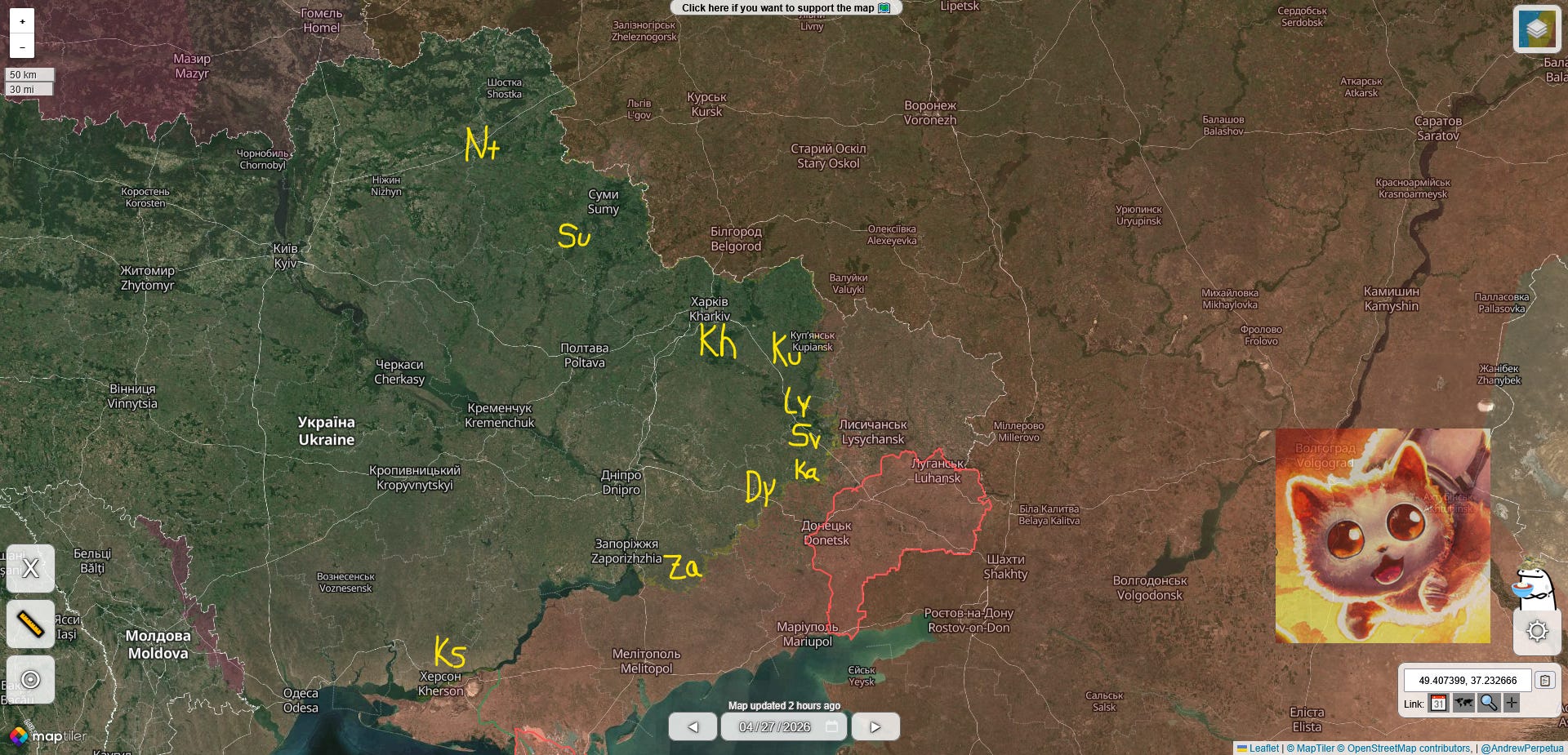
There’s just no getting around how much weaker Muscovite operations are these days. On every front, Ukraine’s biggest challenge is keeping forward positions crewed and occupied because of the threat of drone attack, not losing the position to an assault.
Inability to tolerate casualties is Ukraine’s primary operational weakness. At the tactical and strategic levels, this is actually a strength.
But it does mean that the Ukrainians are often forced to slowly give up positions in a sector the orcs choose to saturate. They’ve got to exhaust the combat potential of whatever fresh forces have been sent at them, then reclaim some while resetting their posture when this wave is worn out, before the next comes in.
That natural ebb and flow gives the illusion of more extensive Muscovite gains than are truly the case. All year orcs have been sent to break through Ukraine’s killzone at any cost. Their successes have been almost entirely neutralized, preventing any major breakthroughs, just enemy footholds in places the Ukrainians had to vacate.
Slowly but surely, this operational approach is bleeding out the enemy. And Ukrainian forces at the tactical level are testing ways to take back ground at minimal cost.
North
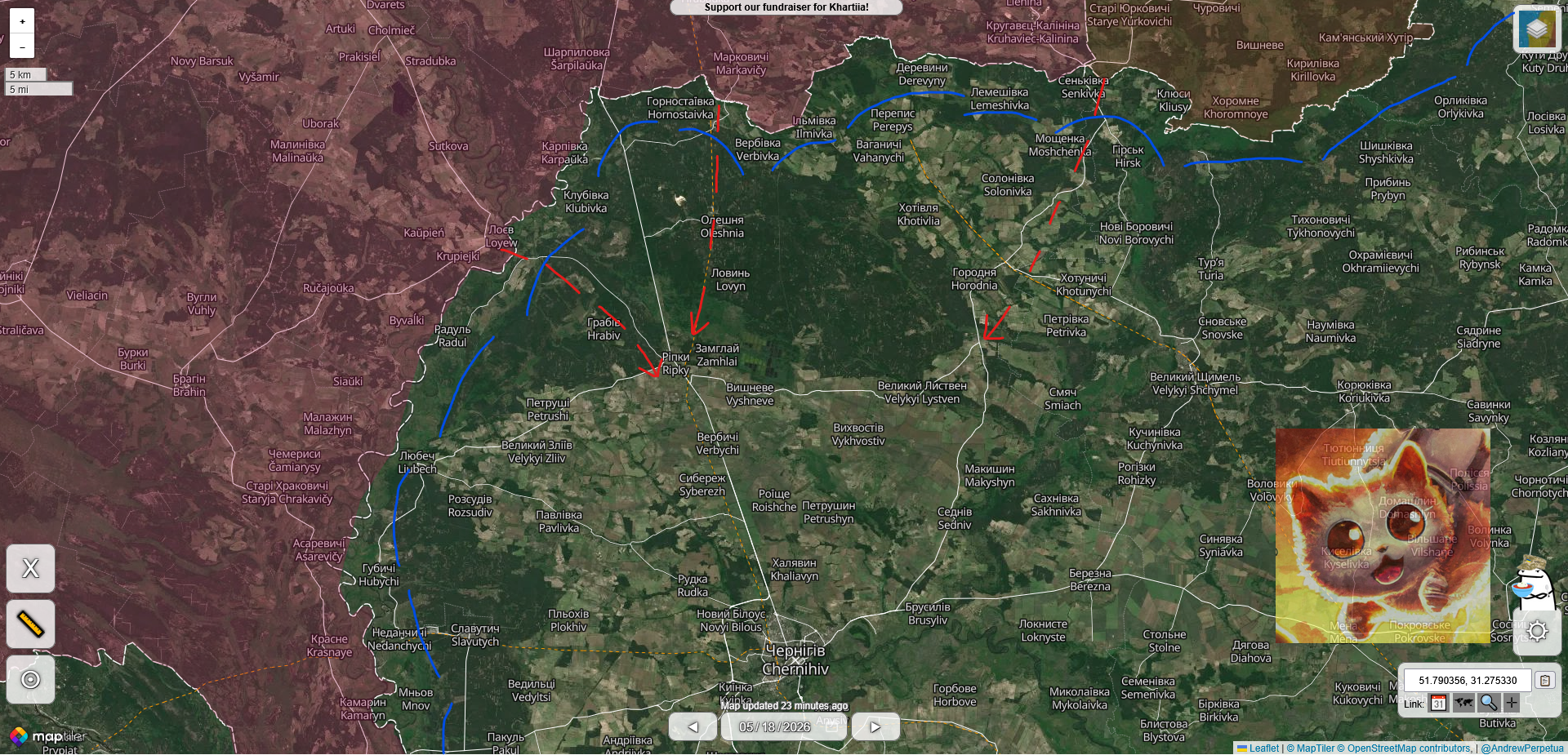
There’s still talk of the north getting hot as Belarus enters the war on Moscow’s behalf. The most plausible option, if this were actually to happen, would be a march on Chernihiv.
Belarus has about enough soldiers to spend three weeks launching assaults before casualties render the standing force combat-ineffective. So they might make it a few kilometers over the border. But they tried exactly this in 2022. And they went straight into 1st Tank Brigade’s training grounds.
In up close and personal tank-on-tank action, the Ukrainians fucked the orcs up, to put it bluntly. Chernihiv, despite being on the direct route to Kyiv east of the Dnipro leading north, was partially encircled but never fell.
This is not auspicious ground to attempt an advance through what is now a drone-infested killzone. About all Belarus and Moscow together could manage is taking some forested areas along the border.
Sumy
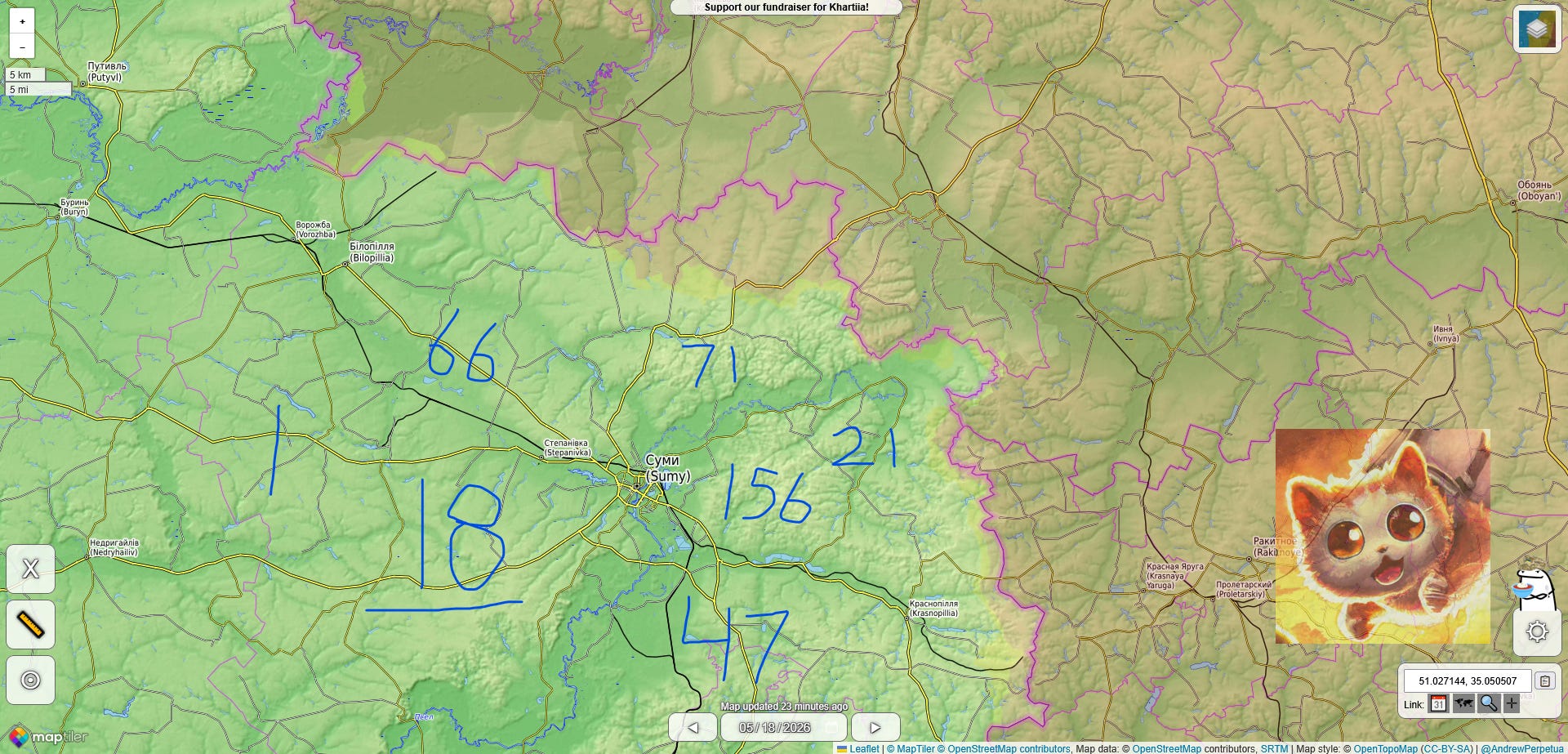
Not a lot of news out of Sumy this week, and no visible enemy advances. 18th Corps is ostensibly managing some of Ukraine’s best equipped and trained brigades - or they once were, anyway, things could have changed. 21st, 47th, and 66th Mechanized, and 1st Heavy Tank are among the organic brigades, and 71st Airmobile (formerly Jager) is presently in the area.
No guarantees that the current open source picture of Ukrainian corps and brigade locations is ever very accurate, but in general 18th has seemed to hang on to its core units instead of having them scattered around. And the level of combat they’re engaged in is definitely less than what’s standard around, say, Dobropillya.
So I’ll be interested to see if individual brigades or the entire corps show up somewhere else. Just because I’m curious about how the corps transition actually works in practice. Big fan of comparative analysis, so the performance records of Ukrainian brigades across the war would be fascinating to pore through. After it’s long over, perhaps..
Kharkiv
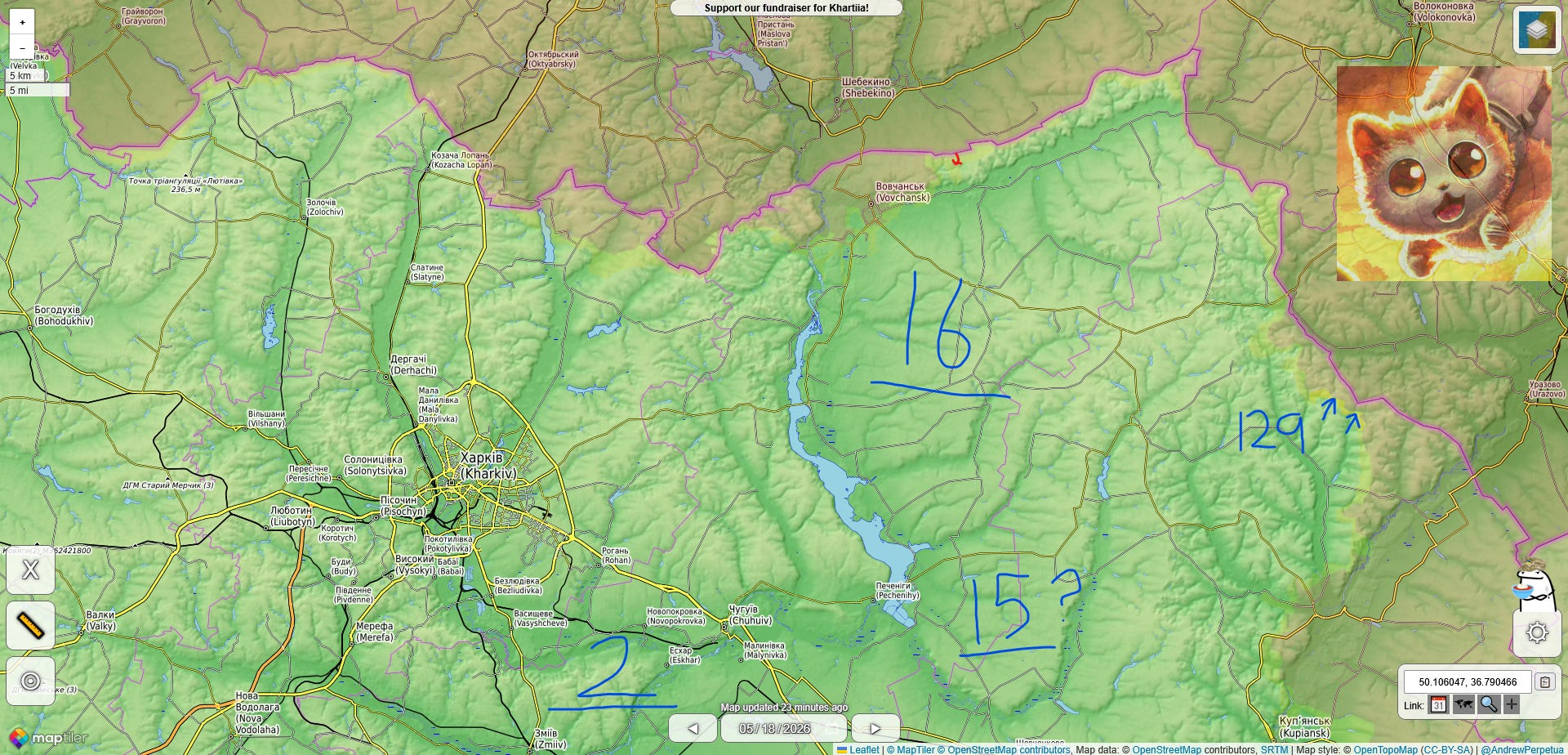
Most of the Kharkiv front has been static, just one small orc success east of Vovchansk. And by success I mean the map shows some enemy troops having moved about a kilometer over the border towards the hamlet of Zybyne. Possibly just one or two.
The Ukrainians had substantially more success further east, liberating the village of Odradne and its surroundings. 129th Heavy Mechanized claimed the op, which showed that Moscow’s probes over the border in this area are not very strongly supported.
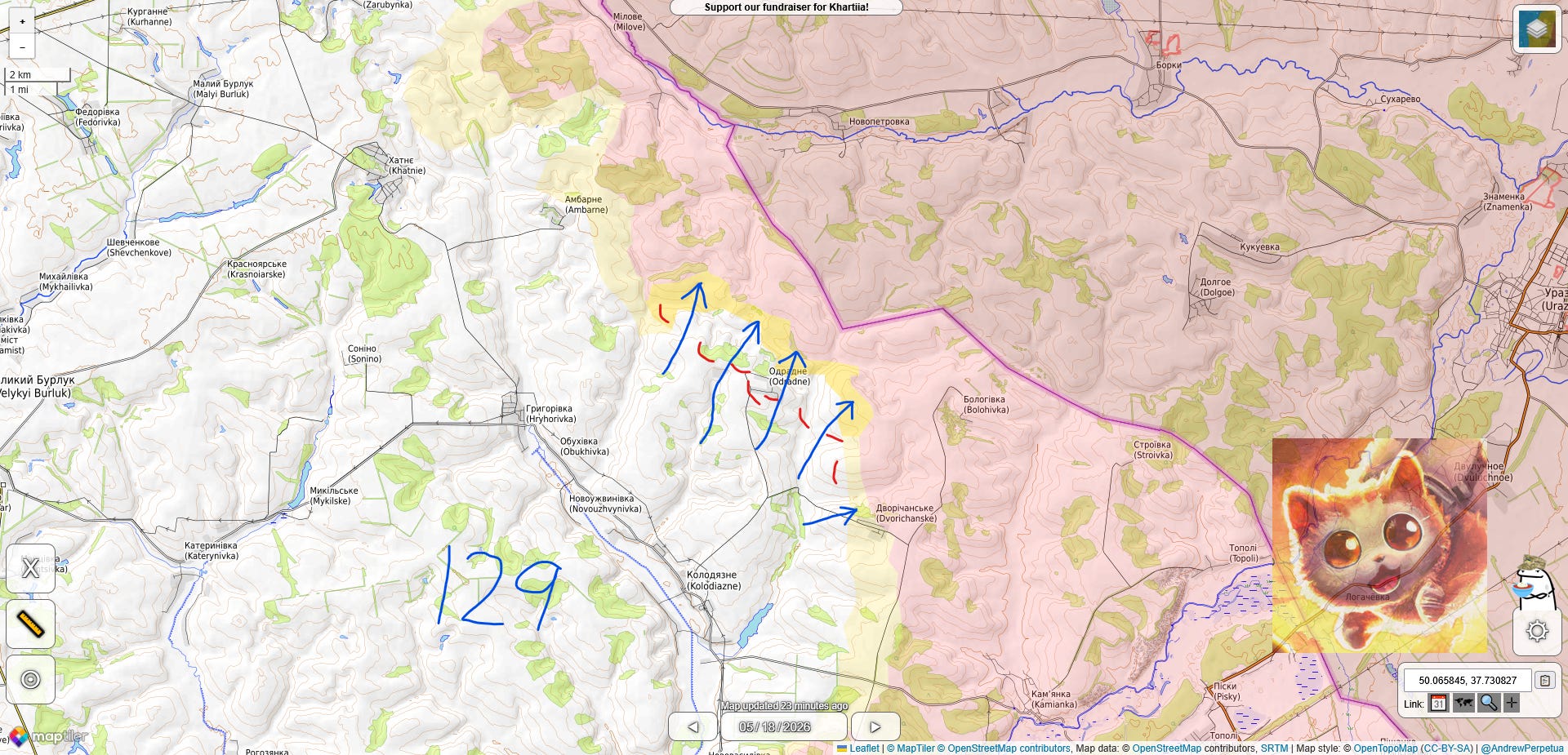
This brigade is nominally assigned to 15th Corps, which appears to be one of those that detaches brigades because it handles a less threatened sector. But 15th might in fact be taking over for 16th in this area, allowing the latter to focus on the approaches to Kharkiv. Or reinforce Kupiansk.
Kupiansk
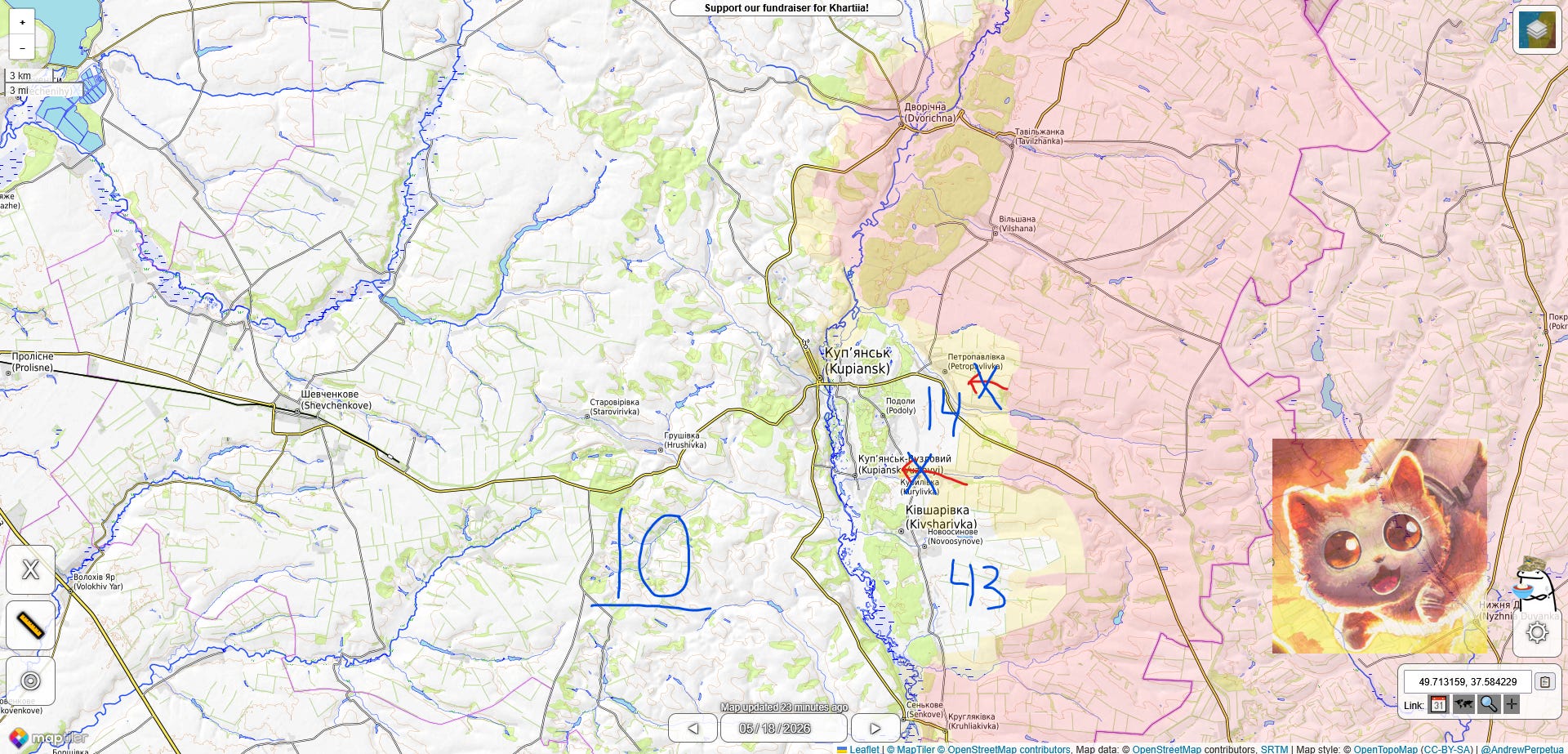
Muscovite forces are still trying to creep towards the Oskil on the Kupiansk front, and 43rd Mech seems to be taking the brunt of their attacks right now. 14th - assuming it hasn’t been rotated, hasn’t lost much ground despite almost certainly having to reset positions, so that’s good news.
Overall, Kupiansk has been something of a cursed front for Moscow. Everything the orcs have tried, from crossing the Oskil at Dvorichna to sending disposables through pipes into downtown, has turned into a costly failure. Even outflanking Ukrainian forces by pushing deeper into rural Kharkiv hasn’t worked.
I would not be surprised if Muscovite attention here waned. Claiming to have taken Kupiansk at this point is pointless, because Moscow has lied about it in the past. The resources tied up trying to take Kupiansk are totally wasted. Even if it fell, that wouldn’t immediately allow the enemy to advance any further.
Lyman
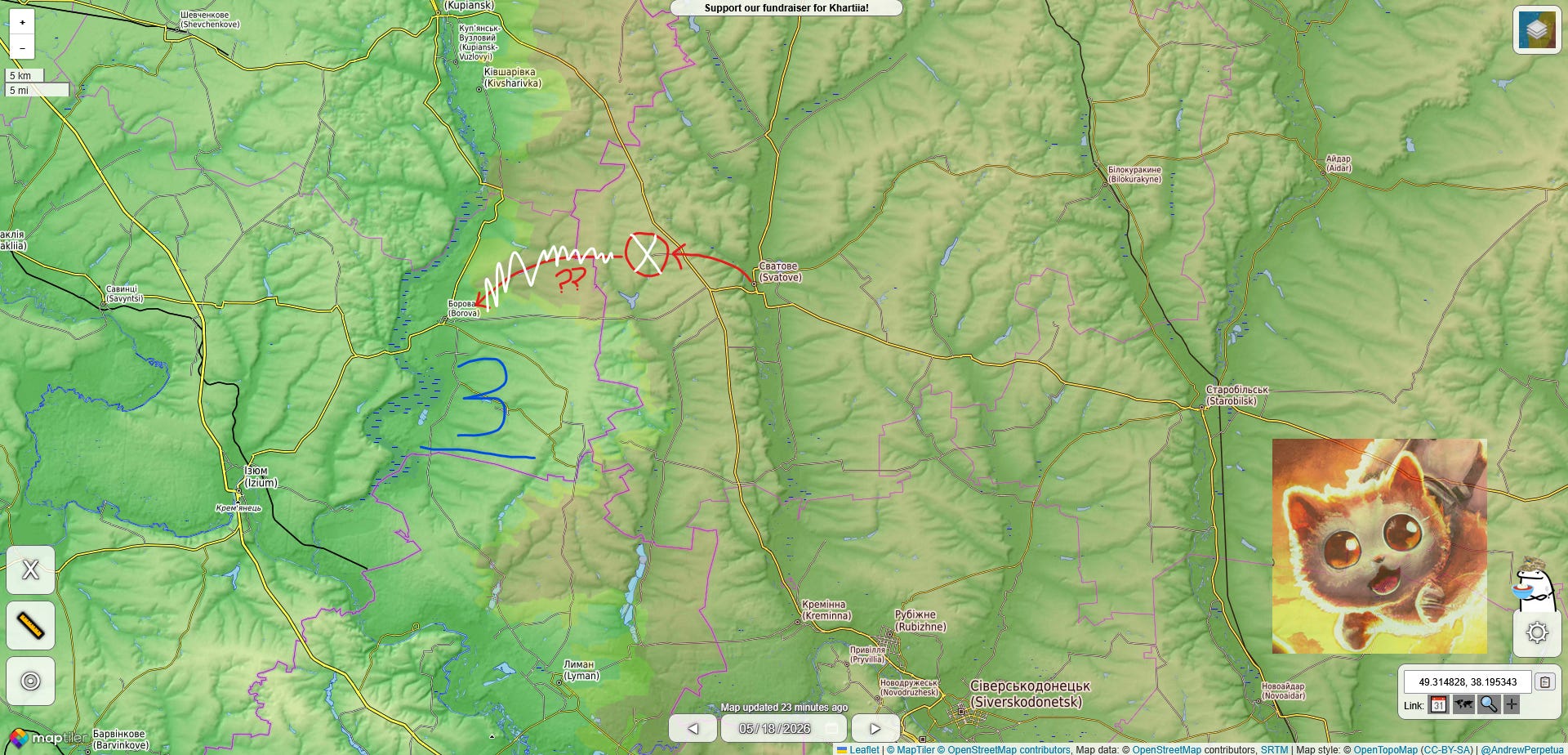
3rd Corps had a bit of fun debunking a faked Muscovite claim of having taken Borova. Some orcs decided to walk around the occupied town of Kolomyichykha and pass it off as Borova. Didn’t fool anyone on the Ukrainian side, but if this was a clever way to walk halfway through the killzone and call it quits, well done, orcs.
Or not, because the soldiers responsible are probably doubly screwed when their false report gets their superiors in trouble. Or who knows, maybe that’s the deal these days: as long as you insist you advanced, your superiors will back you up, and Moscow will pretend that’s the truth of the matter.
By that logic, you’d think the orcs would just insist that they’d taken Sloviansk and let anyone who disputes it drive there to check. I doubt the Ukrainians would miss the opportunity.
Elements of either 3rd or 10th Corps look to have seized some forward enemy positions down by the Siverskyi Donets near Zakitne, further slowing what is already a glacial pace of advance through Yampil. Ownership of the forested ground between Yampil and Dibrova is highly unclear thanks to lack of visibility.
Though two combined arms armies have been bearing down on Lyman for well over a year, they haven’t reached it yet. The level of cover available here should make intense orc attacks more likely heading into summer. But lack of troops may lead to Lyman being given a lower priority than Sloviansk.
Sloviansk
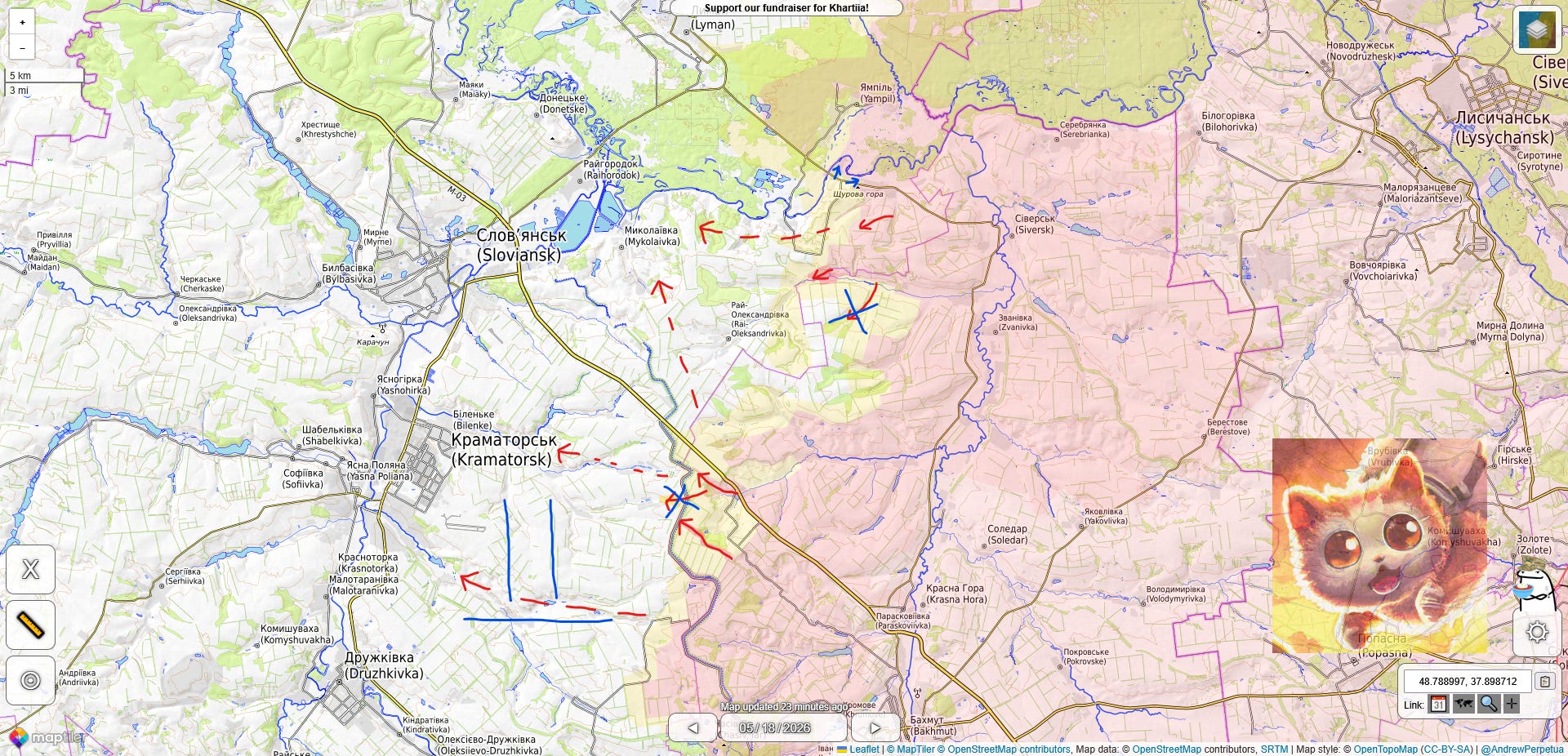
Here the enemy is still fighting to push west of occupied Siversk and up the Bakhmut-Sloviansk highway, and in several moved forward by a kilometer or two. The challenge of pushing through dense Ukrainian fortifications is visible in the slow pace despite a limited number of Ukrainian fighters working here.
11th Corps looks to be reliable again after the command failures which led to the loss of Siversk. They’re essentially conducting a fighting withdrawal, maximizing the potential of the woods between Siversk and Sloviansk to slow enemy progress on the east bank of the Donbas canal. Muscovite soldiers keep working to surround them, but attempts bog down.
I am increasingly suspicious that Putin’s patience with his military will run out, leading to him demanding a simple frontal assault down the road from Bakhmut. So the more damage the Ukrainians can do now, the better. The orcs may have one last intense operation left in them before casualties and logistics conspire to end their potential.
At the moment, if this happens, first the orcs will have to overcome a stiff defense. And without support from the flanks, as neither Lyman nor Kostiantynivka is likely to fall for months to come.
Kostiantynivka
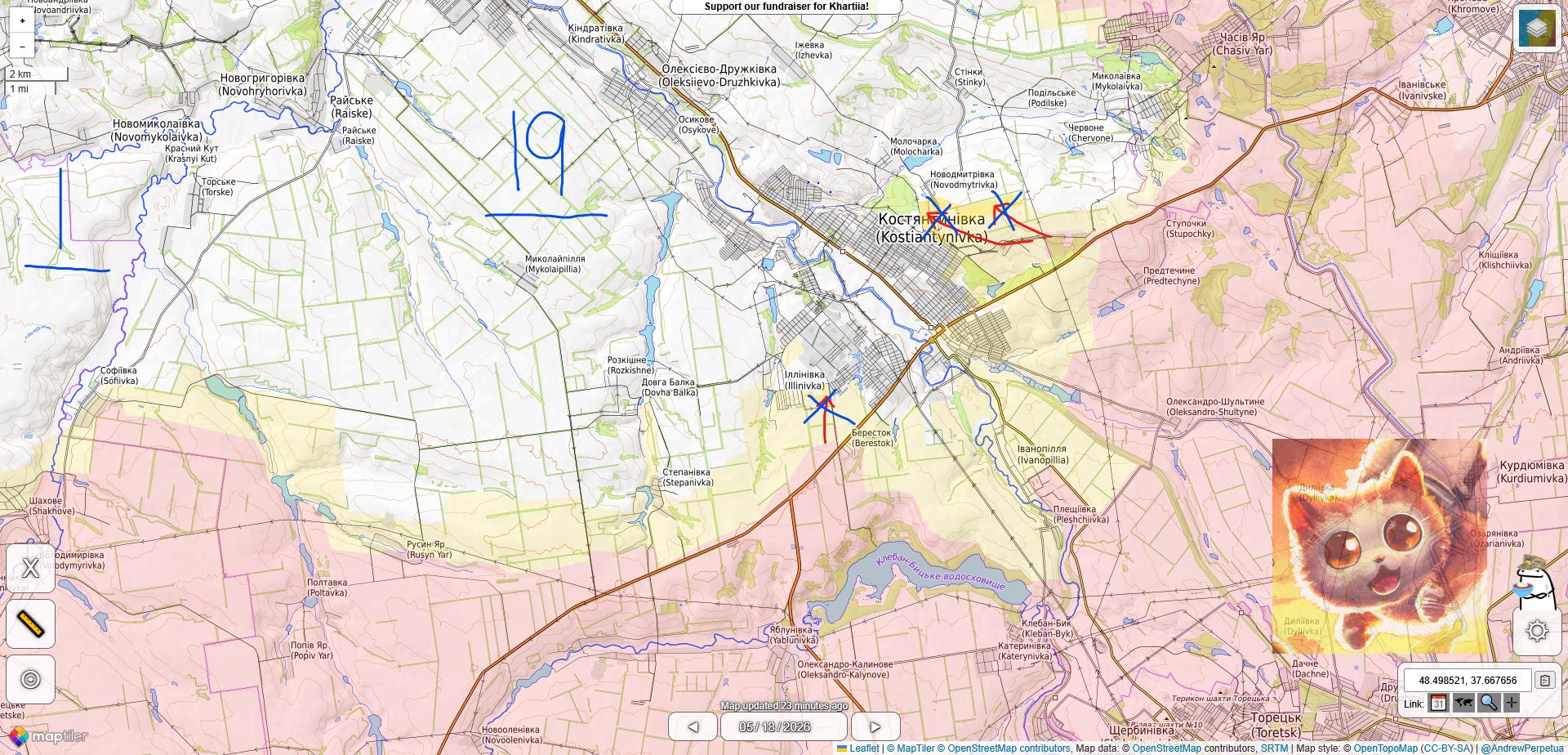
Abandoning intensive flanking efforts looks to be the way of things in Kostiantynivka, with Muscovite attacks out of Chasiv Yar blocked before they even begin, and what’s left of Toretsk almost as dangerous. The orcs have lately emphasized simple head-on attacks with infiltration waves.
19th Corps keeps chewing them up, despite the city itself being ground into dust. They’re familiar with the process, having gone through it in Toretsk and Chasiv Yar before. They don’t talk to the English-speaking press a lot, but associated brigades seem to prioritize early interception of incoming stuff at all costs. The weight of every assault and infiltration attempt is lessened thereby, or they must necessarily be less frequent.
For orcs to get into the fight, they’ve got to somehow get to Kostiantynivka across a few routes with sufficient cover. These are doubtlessly heavily mined, monitored, and zeroed in by artillery. Assaulting the citadel will be a mighty challenge. If Putin’s orc generals hadn’t failed so badly at their jobs, this would never have been tried.
Dobropillya
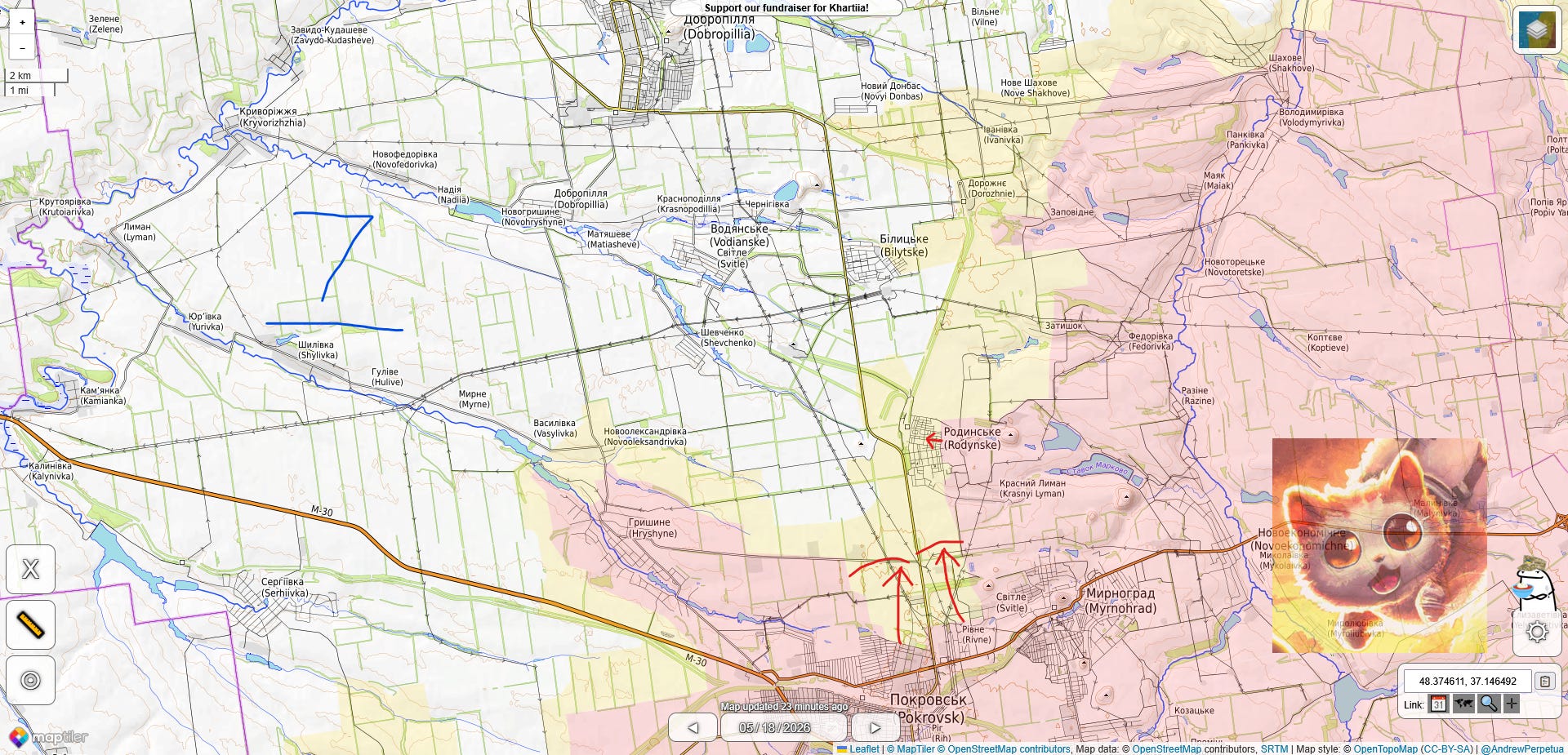
Outflanking the enemy can be so devastating because it threatens supply lines. The enemy has to react, and often fight on terms not conducive to success.
Moscow’s forces stalling out so hard despite taking the Pokrovsk-Myrnohrad area has all but damned the assault on Sloviansk. Flanking the city to the north is very hard, because of all the rivers in the area - Siverskyi Donets, Oskil, so on.
To the south, the ground beyond Pokrovsk is a lot more open. Once across the Kazenyi Torets and in control of the Dobropillya area, you’ve got a clear shot at western Kramatorsk down a major highway, and the edge of Donetsk district at Barvinkove isn’t any tougher to reach.
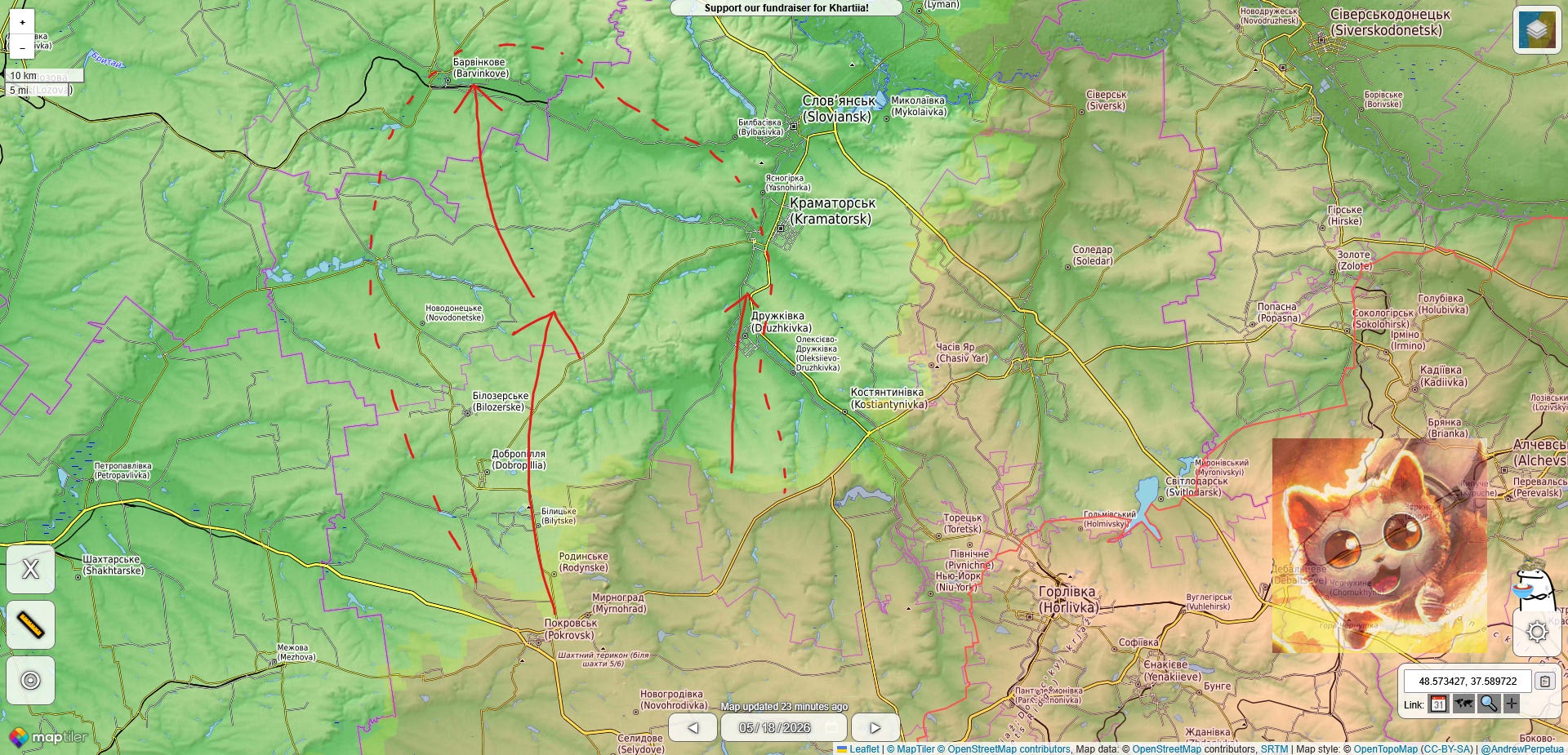
Had Moscow been able to take Pokrovsk sooner, there might have been sufficient momentum left in the long push out of Donetsk to reach these lines, which would have made the defense of Sloviansk unsustainable. Ukraine would have been forced to accept Putin’s demands for a temporary peace. Followed by the next invasion.
Now, thanks to exhaustion of critical assets - like armored vehicles - and falling behind in the drone race, the russians are barely able to mount a push beyond the immediate vicinity of Pokrovsk. Tiny advances are all they can muster, even in places the Ukrainians probably aren’t holding tight to in the first place. That mass infiltration attempt east of Dobropillya last year was the last gasp of this longstanding orc plan.
The orc tide is finally going out. Ukraine’s long Liberation Campaign will intensify.
Pokrovsk itself is actually dangerously vulnerable to a counterattack. Ukrainian drone strikes are still savaging the roads leading east. Pokrovsk is an island that increasingly looks to be just beyond the point Moscow can safely project power, no matter how much artillery is massed there.
A bit like US forces will be if they ever land on one of this islands off Iran. And Israeli soldiers in Lebanon are finding themselves now.
Because the powers that be are gonna do 1914 again.
Zaporizhzhia
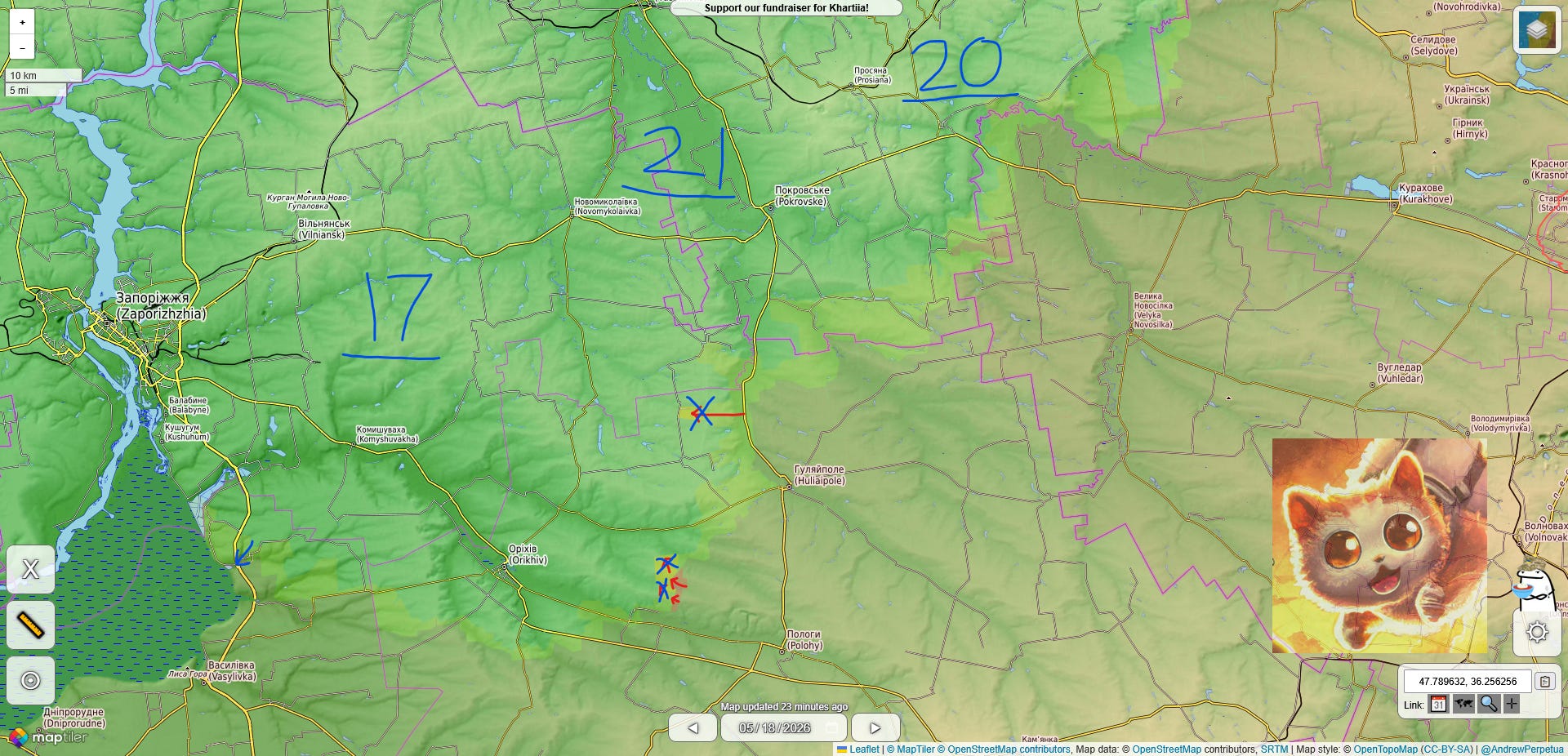
Here too the results of recent fighting have been a very mixed bag for Moscow. A couple minor advances in the Huliaypole area were noted, but if the plan was to break through towards Orikhiv by early summer, this offensive too looks to have stalled.
On the open steppe, even in spring cover is tough to come by. Movements tend to be channeled and predictable. Huliaypole may have fallen, but the paths to it are so dangerous that here, as in Pokrovsk, owning the ruins doesn’t translate into gains beyond.
The Ukrainians for their part have decided that the orc advances towards Zaporizhzhia earlier this year stand to be reversed. In Stepnohirsk the latest news has it that Ukrainian forces have cleared the whole place, which will cut off any infiltrators that had made it further north.
It’s really hard seeing the orcs making it to Orikhiv, though a Ukrainian collapse could make it possible. But those no longer seem to happen at the brigade level like they used to.
Kherson
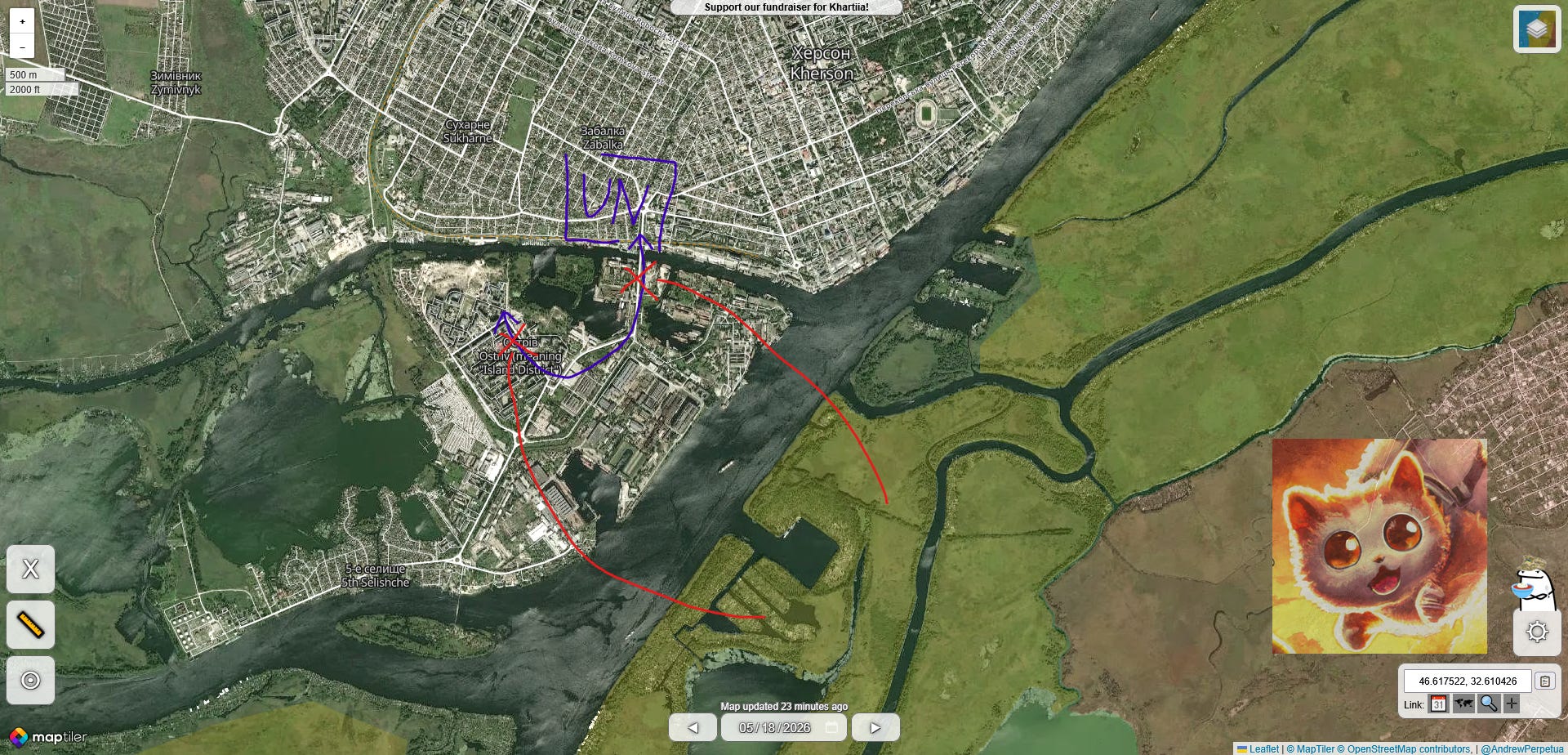
No changes in occupied Kherson this week. Some United Nations dudes got to experience what life is like there, though, thanks to the orc human safari. Intercepted or recovered Muscovite drone feeds confirm deliberate attacks on marked UN vehicles in the city. Because orcs.
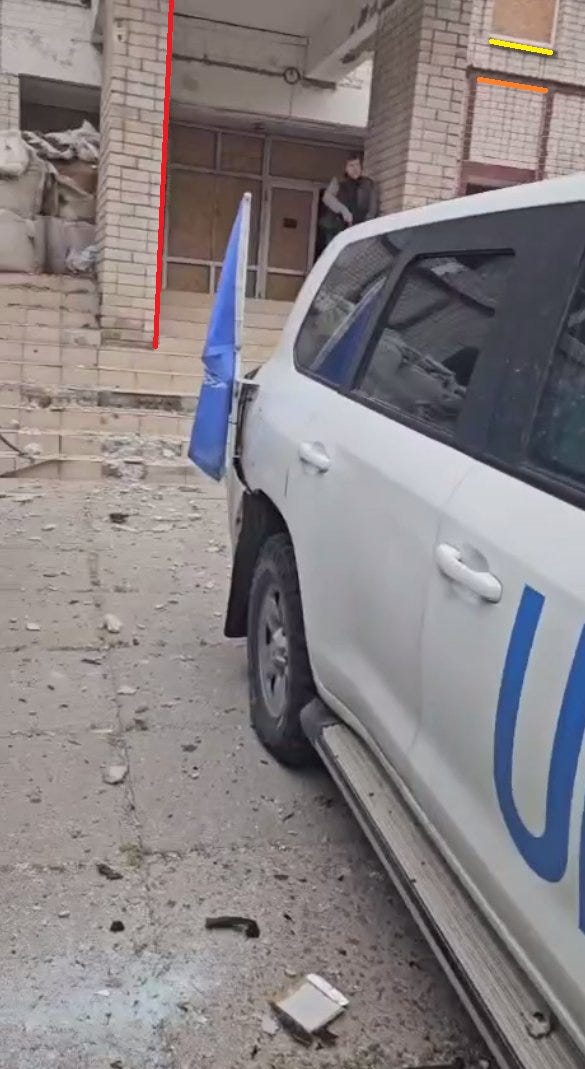
The UN, incredibly, didn’t even identify who attacked them. What an irrelevant organization. League of Nations 2.0 after all. I expect it to share LoN’s fate.
You want international governance? Better build something new - and binding. I favor a loose federation composed of autonomous regions, self-defined. Ukraine had better be at the heart. With the USA probably falling apart, Cascadia (Oregon + Washington) ought to be involved too.
A Ukraine-Cascadia Alliance would be cool regardless. Hey, Moscow once claimed us too. Might again in the future. Think D.C. would care? I don’t any more.
All I know is that whatever happens, what’s been going on in Kherson the past few years is as deserving of international humanitarian intervention as any other place where civilians are dying. Responsibility to Protect was good for breaking up Libya, but not safeguarding Ukraine?
Got it, NATO and collective West. Understood.
Strike Campaigns
I’ve already covered the big picture in the deep strike game, though there are some operational level details of interest to note. First was Moscow’s use of dense streams of drones moving along Ukraine’s borders with Belarus and Moldova to reach the far west, which is often seen as a relative haven.
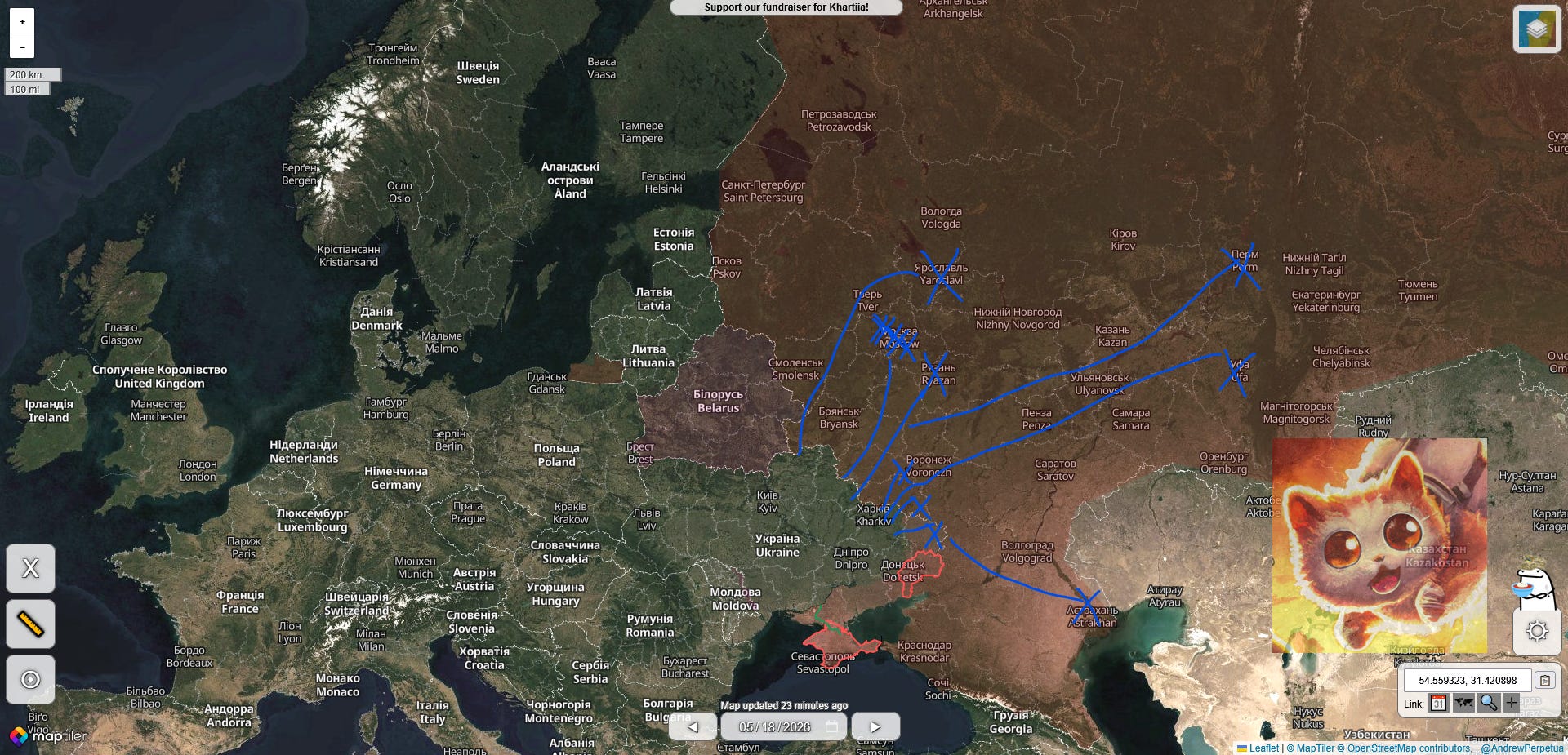
These bomber streams have been tried on Kyiv before, and the orcs are always trying to confuse Ukrainian forces with decoys and deceptive flight paths. This is the first time they’ve stretched to the Polish and Hungarian borders, though. Definitely sending a message to NATO, which is likely under-prepared for any form of orc drone assault.
I don’t focus that much on orc tactics because they are always changing, both on their own initiative and in response to Ukrainian defensive innovations. Shaheds may fly higher or lower, solo or in groups of all sizes, and even attack mobile fire teams. These tactics cycle constantly.
It isn’t that the orcs don’t ever adapt, but that they do it too slowly and rarely at the right level. You always have to be ready for the russians to try anything, no matter how dumb or crazy.
But they apparently wouldn’t be russian if they didn’t sit in a hierarchy where obeying orders from above is a moral good unto itself. And as the people issuing those orders must always conform to their own mythology about mighty russia, sanity does not prevail. Operations, therefore, don’t live up to expectations.
This is why Moscow keeps launching scattershot drone and missile attacks on Ukraine, sometimes taking a few days to save up weapons for a really big wave. It’s about appearances, not sound military operational logic. The damage rate never exceeds Ukraine’s rate of repair.
By necessity, Ukrainians have gotten good at fixing infrastructure. So if you want to knock out something important to them, you have to hit it over and over. Trying to go after railways across Ukraine is a sensible military action, but it doesn’t amount to anything if a follow-up doesn’t undo any repairs.
Moscow’s drone attacks are always switching targets, no doubt in part to keep Ukrainian defenses moving around. But this also means that drone raids rarely break the skin, as it were, as irritating as the bruises they leave might be.
Using drones against Ukraine will spread out defenses and terrorize the population, but they can’t on their own destroy enough critical infrastructure to let russia bombard the Ukrainians into submission. Ukrainian defensive efforts that score 90-95% kill rates plus the number of targets to be repeatedly hit makes this impossible.
And it ought to go without saying that if an Iskander or Kinzhal can destroy it, at this stage it probably isn’t critical to Ukraine’s war effort. Factories and depots are carefully scattered and the system maximally decentralized, ensuring that successful strikes don’t paralyze production as a whole. Energy infrastructure is a partial exception, at least in winter, because of the impact on civilians and necessary centralization of major facilities.
But Ukrainian defenses are robust enough and decentralization in most areas sufficiently extensive to make the value of most Iskander attacks lower than the cost of the weapon. Since drone targets are forever shifting and different weapons are used to fight missiles and drones, there’s little synergy between the drone and missile campaigns.
In short: Moscow’s strategic strike campaign remains insufficiently focused or heavy enough to achieve more than killing civilians while delaying the inevitable for maybe a few weeks or months. It’s about inflicting punishment on the theory that there’s some invisible meter in Ukraine that ticks up with every attack, with cumulative impacts over time.
These have never been observed. Inflicting punishment does not deter. The ability to do it may deter if the opponent is motivated solely by opportunism.
Ukraine’s own deep strike campaign is going after a category of targets that collectively represent the Achilles’ heel of Moscow’s war machine. Oil infrastructure takes time to rebuild, and without the revenues it provides Moscow’s economy dies.
It will absolutely get tougher for Moscow as time goes by. Ukrainian ballistic missiles will complicate orc defensive efforts substantially. Moscow can shoot them down, but this is a whole other layer that has to be managed during attacks. Combining ballistic and cruise missiles with drone strikes on air defense systems ought to create impossible dilemmas for their operators and boost attrition, which will support subsequent attacks.
Mid-range Ukrainian strikes continue to reap a terrible toll across the occupied territories. The isolation of Crimea and occupied Kherson is visibly underway.
By hitting road, rail, and ferry connections, the Ukrainians are making everything west of Mariupol a graveyard for orc logistics. The Kerch Strait bridge is bound to get smacked hard again this year at this rate. Taking down parts of the S-500 system dispatched to protect it is likely a prerequisite. Naval drones armed with FPVs could be ideal for getting at large S-500 components, like radars.
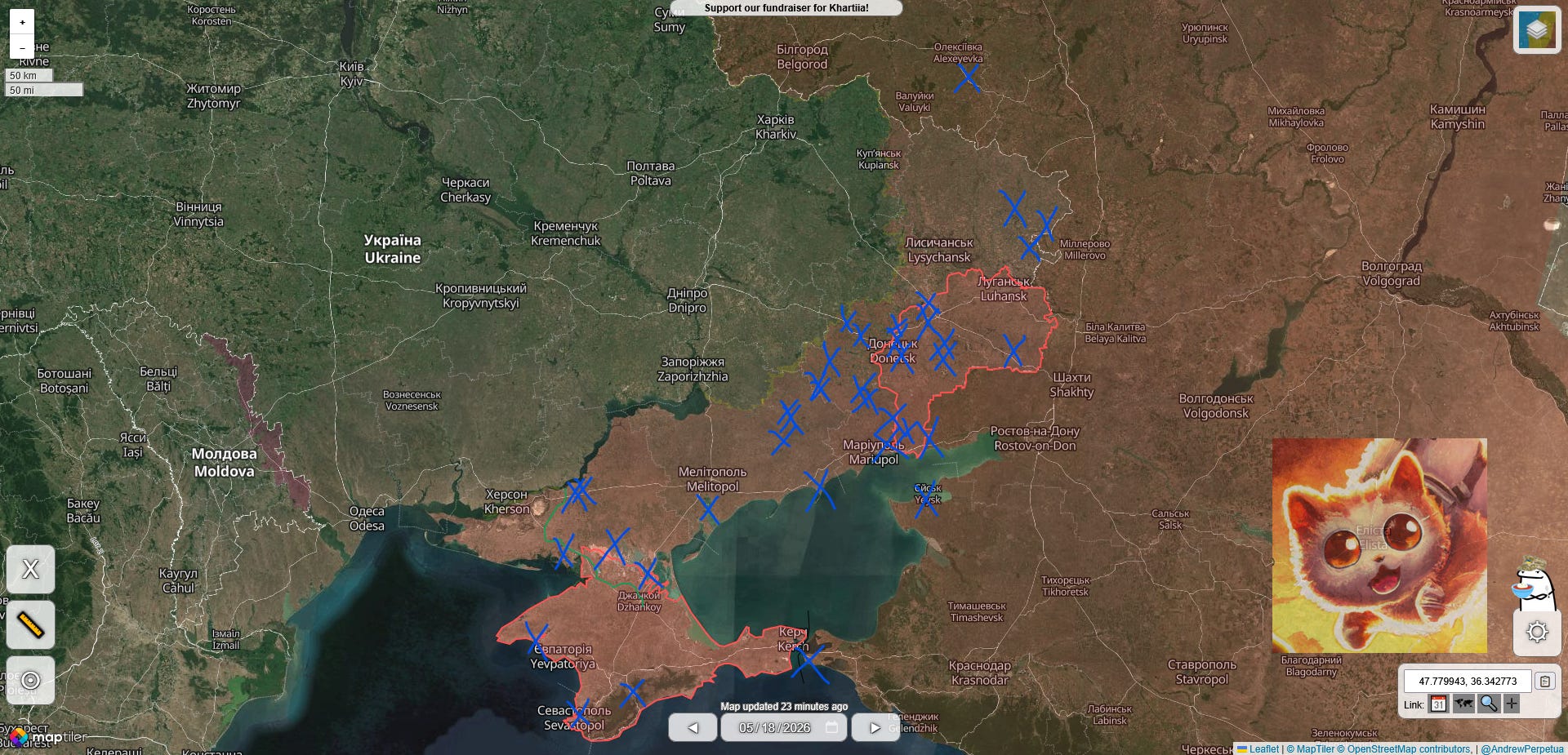
I’ve long considered the operational, or middle, strike campaign to be as important as the deep strategic hits. Moscow could actually take the risk of full mobilization despite the attendant risks, estimating that if the economy is about to collapse anyway, a fully militarized russia is primed to divert public energies away from the capitol when things get tough.
An old man like Putin who doesn’t really understand the internet is bound to be attracted by escalating in the only way he practically can if the sole alternative is bitter retreat. Seems to be the way of these egomaniacs.
I’m beginning to wonder, incidentally, if parts of Team Trump actually do imagine that they might somehow remain in power past the expiration date on his final term by hiding out under their dystopian ballroom. As if D.C. hacks in the swamp need more shiny things to enjoy. Wasn’t it supposed to be drained instead? Oh, wait, MAGA has always been a cruel con. Forgot about that. For about half a second.
Again, I’m no fan of the Democrats, but boy do I really loathe what MAGA has become. Can’t say I ever trusted it in first place, but my opposition to Trump has always been strictly tied to the man, not the movement, even if it isn’t to my own taste.
Anyway, always gotta consider the risk that the enemy is bound and determined to commit suicide while taking you down with them. In which case, turning back to russia and Putin, Ukraine withstanding the shock of any mobilization will depend on the efficiency of the drone line and operational strike efforts more than strategic campaign.
Severing enemy logistics to occupied Ukraine may reach the level necessary to cause the orc lines to collapse - in several places. That and killing fifty thousand russians every month.
To that end, the Ukrainians have in just the past few days amped up the killing power of their strike drones by incorporating a salvo of small rockets. These can fire in the seconds before impact on a target to break up anti-drone netting, or be independently fired en route to a target at mobile fire teams.
Another big step for Ukrainian drone operations.
Drones using independent small munitions of their own is certain to become a thing in the coming years. They’re on track to be employed like miniature strike jets and attack helicopters. Decentralized, on-demand precision strike capabilities are set to make life very difficult for anybody moving out of cover, even if they’ve got short-range anti-drone defenses.
Better interceptor drones will surely follow. Here too the Ukrainians stand to maintain a decisive edge.
Air, Sea & Signals
Air
Nothing big to report on the aviation side of things, except for a very intriguing Fire Point project that aims to combine existing European radars and seekers with an indigenous Ukrainian missile body. Appropriately named Freya, after the Norse goddess of fertility and warfare1, this project aims to give Ukraine reliable ballistic missile protection starting late next year.
So not soon enough for this winter, and hopefully the war is over before it’s even deployed. But after the conflict, even money Freya is bound to become Europe’s most widely-used ballistic missile interceptor. Solid bet that Aster upgrades will offer a high-end capability, protecting stuff that simply can’t be lost. Freya most likely has less precise tracking and weaker maneuvering, compensating with a bigger warhead.
Ideally, for taking out ballistics, you want a hit-to-kill projectile that is able to totally demolish an inbound warhead. Lesson learned during the Gulf War when Patriots were able to technically knock down SCUDs, but wreckage hurt people on the ground.
It’s not like with a cruise missile where you can pick an intercept point along it’s route where the weapon will fall away from important things. Ballistics on terminal approach are coming straight down, and mid-course intercept is complicated by the fact that missiles can maneuver until the terminal phase, sometimes even during, though with less of a range.
Freya is likely a point-defense weapon which will aim to make the enemy projectile detonate far enough up during its terminal dive to shower smaller bits of wreckage instead of punching down through a building or bunker. Might also be capable of mid-course destruction, before the warhead goes vertical.
The potential for an air-launched anti-ballistic missile could be worth looking into. A version of Freya with less fuel but a bigger warhead could work well.
Sea
Beyond that stray Ukrainian naval drone the Greeks picked up, and some aerial drones hitting patrol vessels, a cargo ship bonked in Berdiansk by a FP-2 is about all there was to note in the floating domain. That russian cargo convoy I wrote about last week is still heading towards Singapore, final destination unknown.
There was an interesting tidbit in the news about an orc vessel that was sunk off Spain a couple years back. Allegedly it was bound for North Korea, carrying nuclear reactor components. An investigation claims that the ship was initially hit by something that left blast damage suggesting a hit by a supercavitating torpedo - basically one that moves really fast. Moscow later sent a recovery vessel that blew up the wreckage, adding to suspicion that the cargo was sensitive.
Only rarely are stories that suggest serious covert ops actually legit. The most out-there stories are typically wrong. But this one has come together over time and as a result of independent inquiries, suggesting that someone actually did do something back in 2024 to send a message about the visibility of and willingness to mess with shipments of nuclear technology.
Or there was a simple accident. The ship was being escorted by russian warships, and russia is one of the only countries to have ever officially deployed this kind of weapon. The US and a German company looked into it, so not out of the question for covert ops to have some. Yet I can’t see Joe Biden authorizing an act of war. The UK or France, though, maybe.
Were I to bet, though, I’d put my money on a russian screwup. Could even have been an “accident” if the russians didn’t actually want the cargo to reach Pyongyang.
Given the inherent uncertainty, I’d be really intrigued to see something like this happen again.
Signals
Alright, this section gets a bit out there, so fair warning. I just feel like it’s worth commenting on the AI hype of it all.
Pretty much everyone seems to agree that advances in AI are the next wave of innovation that will shape the future battlefield. They’re not wrong, but also not right in the way most think.
I don’t want to make this post insanely long by doing a full deep-dive into the Great AI Con of the 2020s, but a brief overview is worthwhile. Automation will play a huge role in security affairs, no doubt. But talk about AI has gone off the rails and jumped the shark at the same time, somehow.
To sum up the truly massive economic bomb that’s hovering over the global economy right now, it’s enough to say that this is the Dotcom Bubble all over again, but with the dial twisted up to about thirteen (scale traditionally goes to ten). Only this time the bond market, which tends to keep the macroeconomy somewhat chained to reality, is tanking thanks to geopolitical uncertainty. As a result, money keeps chasing the AI bubble in the stock market because it’s the only place to make money or even tread water.
This is like what happens when an invasive weed takes over a field. It crowds out a diverse ecosystem and, when it reaches the point in its natural life cycle where it does and goes to seed, the whole field becomes barren.
Eventually there will be a disruption that resets the crazy stock market. Hormuz closure and all the inevitable downstream impacts looks like a sure guarantee of trouble. Which is why the people who have been all-in on companies that have branded themselves as doing AI are so determined to tell you that AI will change everything. Keep up that pump at any cost!
The scam runs so deep that even talking about it at all helps uphold the thing. All commentators, as the story goes, must either be for or against: there is no middle ground. Which is the first and most compelling sign that a pump and dump game is afoot.
Good AI tools are undeniably amazing. The way so many people are using the term AI any more, however, is as a simple synonym for technology in general.
99% of the hype and panic surrounding the latest generation of technological tools comes down to influential professionals who communicate for a living and do it according to rules they’ve chosen to obscure or forget facing up to just how rote and repetitive their output has always been. A couple decades ago someone built a solid generator of viable Tom Friedman columns based on that incredibly banal New York Times columnist working to such a tight script.
All you had to do was enter in a few words, and the generator would spit out something superior to anything the man ever put into a word processor.
When the illusionist’s tricks are revealed, they face a hard binary choice: insist that whoever revealed them has access to some kind of special ability, or appeal to the audience by warning that performances of illusion will soon be no more if the audience doesn’t reject the heretical new thing.
It’s all part of the theater. Willing audience members who get enthusiastic about anything with sufficient hype or like to feel as if they know stuff nobody else could complete the performance.
I can’t think of a single documented historic instance of rapid technological change failing to produce exactly this dynamic. Hucksters rule until people educate themselves and regain a degree of healthy skepticism.
Most discussion of AI these days is vapid and pointless, especially any and all which aims to regulate the thing. You might as well declare whole branches of math to be the dark arts and restrict learning. Granted, many humanities and liberal arts types and their students would dearly love for this to happen, but they’d regret it when they were starving to death a few years later.
Although almost as idiotic is the position that AI is set to transform everything, everywhere, forever, overnight. I can also foretell that the sun will appear in the sky, even if shrouded by fog or smoke, within twenty-four hours. Or that if you are reading this, air still exists.
The people out there hyping some AI apocalypse where there will be no jobs or - even more laughably - they decide to kill all humans are just taking part in a pump and dump scheme for the ages. It’s a big social performance with macroeconomic consequences.
A small group of companies are stringing investors along with wild claims about everything they’re going to disrupt and replace with their amazing AI products. At absolutely no point have valuations of any of the companies benefiting from the AI bubble been borne out by anything material. It’s all speculation, with the caveat that certain kinds of infrastructure, like data centers, are bound to be valuable because of the potential for cheap computing to do all kinds of good. But how valuable? Open question. When too many people ask it, watch out.
It’s not that nobody will come out of the current business cycle a winner, but that first there’s bound to be a serious adjustment which creates a whole lot of losers. That’s how the current generation of tech giants came to be - they won the last round. Way things typically go, they’re the ones who are bound to lose the second, and they’re holding back true progress by distracting people with bullshit.
Big Tech is a small world filled with dweebs who act like cartoon characters because too many investors mistake a large following or the right connections for guaranteed returns. And every time there are advances, first comes a phase where hype runs faster than reality, sparking a deviation between expectations and outcomes which triggers a confidence crisis and crash.
Anyone who jumped into the bubble early on has a strong incentive to convince anyone who will listen that it will inflate forever. So long as they see people following after, they can hold and watch their present value rise with the tide. As soon as they sense the machine is starting to falter, they can get out - even while telling others to stay in.
Media types happily go along with this because everyone paying attention to daily turns in the global news feed suits them fine. The system merrily trundles along until it suddenly doesn’t. Then the game of musical chairs begins. Who is more likely to lose - insiders, or the average investor?
Nearly all coverage of AI and its applications in warfare, especially Ukraine, wind up tainted by the constant tug of war between bears and bulls seeking signals that sustain their investment strategy. And people play all sides.
Applied digital algorithms are what most people really mean when they talk about AI these days. They aren’t magical, they’re just manipulations of signals with math. They may have dozens, hundreds, or even thousands of different terms, but the essential form is still A = B + C…, where output A is a function of distinct inputs.
Algebra, statistics, calculus - there are a bunch of different branches of math which all have utility in generating tractable models. These models are in effect scientific theories which are then applied to investigate variation in datasets. What makes them “intelligent” is their ability to incorporate terms which can look back or project ahead based on available data and the model.
Most human speech is highly redundant, with around 50% of the words in an English sentence ordained by the existence of others. The way arguments are constructed is affected by how we were taught to reason in school. We all mimic rules we think convey the meaning we intend. Chatbots are only following in our wake.
What makes AI agents so powerful is that they can leverage that predictability to generate useful stuff from vast troves of data. The trouble with the internet since about 2005 has been the sheer magnitude of content out there. AI is disrupting online media because an AI agent doesn’t care about ads, leading to all affected industries casting AI in apocalyptic terms.
Aside from grave issues with Wall Street acting like it’s 1928 again, all the AI hype tends to cloud the fact that without trained operators, AI is close to useless. It’s the integration of human and digital intelligence which will drive the innovation wave which emerges from the ruin of the current AI craze.
This has already begun in Ukraine. There, what everyone is calling AI these days is nothing more than the automation of repetitive tasks.
Just, that’s not so straightforward when the task involves guiding a vehicle to a specific location using image recognition and its onboard cameras.
All observation depends on signals. Light that strikes an object is reflected, absorbed, or re-emitted at a lower energy level. An observer receives light that has interacted with the object and uses its characteristics to understand what it’s made of. Patterns in the light coming off objects enables our eyes, or a machine, to detect something we care about from the background.
Discerning pattern from noise demands training, either through experience or by having an algorithm pore over datasets. All “artificial intelligence” actually means is a set of linked algorithms that self-regulate in some way based on inputs. It isn’t new.
A thermostat is baby AI. Missiles have been using AI since a bit after World War Two. AI is simply better than ever now, because of faster computing and more data. Yet it has very hard limits. These get discovered every time AI products try to scale in the real world.
In Ukraine, increasing automation of time-consuming tasks, like an operator flying a drone from point A to point B over uncontested skies, is the first obvious application of improvements in autonomy. Where selecting a target based on spectral characteristics is prone to so much error that this would be unsafe for friendly personnel, terrain matching stands to be very powerful.
Even in the absence of a true digital swarm, which relies on some kind of controlling intelligence, drone flocks relying on a human operator can provide steady stream of readily available drones. The more time a skilled operator spends doing what human minds are still generally better at than technology, the better.
Ideally, operators are constantly pursuing targets, with assistants launching them about as fast as they can be used. Why waste a human’s attention on a repetitive task when the right software can do it just as well?
In short: between the poles of AI boosterism and doomerism is everything actually interesting and relevant. The future belongs to cyborgs and other hybrids. No one technology will rule. It’s always gonna be an ecosystem, the more diverse the healthier for all.
Ukraine’s drone fight is entering the summer phase of the adaptive cycle, where proven innovations are scaled and fine-tuned for maximum efficiency. At every level, the goal is to bring Ukraine’s drone reality in line with potential. AI is part of this, but only one.
At present, it looks like networks of remote turrets and drone interceptors will be the necessary game-changing technology that render drone flocks obsolete, and create a lot of risk for digital swarms powered by sophisticated algorithms, too. From there, I expect to see the emergence of fighter drones covering bomber drones, both increasingly employing laser-guided rockets to hit targets from a distance.
Yet barring a serious turnaround, Moscow will always lag behind Ukraine. The orcs lack the intellectual flexibility to pursue the anarchic development system that has almost accidentally worked out in Ukraine. As much due to citizen efforts as the government.
Staff Affairs
I continue to gain respect for old Magyar, because he’s one of the few leaders around willing to state things in plain terms. Witty dude, too - gotta love his taunts.
He’s come up with a simple benchmark for success on the battlefield in 2026. If Ukrainian drone operators, of which there are now 4,000-5,000 of based on his numbers, can each kill ten orcs during a twenty-day combat month, Moscow bleeds out. It’s over.
It’s really as simple as that. Math doesn’t lie.
Getting at the requisite number of targets isn’t always going to be easy, because the enemy doesn’t sent that many forward. You’ve got to go hunting. But the tools to do that with minimal risk are coming.
Though brutal, his logic is refreshing. Normal military thinking isn’t liable to set an individual goal like that. An advantage of porting proven concepts from the business world is breaking the intellectual isolation that bedevils security affairs. In total war, numbers are relentless. You’re either on top of making systemic adaptations, or you lose.
The emergence of a new generation of leaders less beholden to the traditional way of doing things is usually a happy side effect of a massive war. That there has been substantial leadership turnover in Kyiv since 2022 is a good thing. Yermak, Zelensky’s chief of staff before Budanov, appears to have definitely crossed the line and thrown in with some of Ukraine’s oligarchs. Good thing Zelensky got rid of him. Budanov is much more effective.
Losing some of the connections to rich types abroad that having Yermak types around enables does hurt Ukraine’s standing in the foreign press, but that has all but ceased to matter all that much. What I found most intriguing about the latest batch of corruption allegations surrounding Yermak and his associate Mindich was the latter talking about Fire Point exactly like sleazeballs who leverage contacts always do.
Some Ukrainian outlets were suggesting that Mindich was talking in several released audio recordings as if he ran the company. But what he was actually saying was stuff anyone could, and deal-maker types often will. He referred to the company needing money as if he was an insider, which is a classic tactic employed when someone wants to imply they have a stake because they aim to profit from this impression.
Very simple con to walk around confidently telling rich people that a company you claim to be associated with is bound to make huge profits if given the right level of investment now. If you get a check, you can turn right around and use it as leverage to get an in with the company if it’s shady.
No hard evidence that Fire Point is one of those so far. Just a startup with a rising profile, which makes it a juicy target for hucksters like these. Could have fallen, but probably just has to associate with nasty people to operate.
You learn some things working a couple years for a Silicon Valley startup designed to be bought by a competitor it threatened, not because it produced jack squat. Just saying.
Simply put: there’s an ongoing information war meme out there which aims to paint Ukraine as corrupt by any means necessary. Yes, russia is involved, but US interests are in the mix too. Fire Point is a threat, simple as that. So it must be implicated in corruption somehow.
Look at how a bunch of rich oligarch types interested in big-ticket contracts went with Trump to China. They really do dream of a world split between Oceania, Eurasia, and Eastasia where they and their money move freely between while the rest of us die in petty frontier wars when ordered to, or our deal leaders decide the time has come for a few drone and missile exchanges.
They are in fact that pathetic. Hopefully the lot of them go bankrupt in the next recession. If big tech companies get bailed out at the expense of the little guy this time, I bet heads will literally roll.
Geopolitical Theater
Speaking of, the world is still waiting to see what the heck is going to happen around Hormuz. Team Trump is still playing games with the media and markets, trying desperately to project the illusion of being in control.
Guy isn’t, though. Far from it. Flailing around screaming for help like a drowning man is more like it. IRGC still has his groin in a tight grip, and keeps on squeezing.
Trump’s latest ploy is to say that he was just about to bomb Iran again when he mercifully decided to let talks continue a bit longer. As he seems to always start the week trying to reassure Wall Street, gotta expect that’s also a warning that the war is set to resume soon.
Trump has trapped himself in a position where if he doesn’t unleash total destruction on Iran, he’s bound to look like he chickened out, no matter what is agreed, unless Iran publicly surrenders. IRGC ain’t doing that, so it’s difficult to see how Trump’s wounded ego can declare victory and move on without inflicting some more pain.
State of play in the region remains roughly like so: Kuwait, Bahrain, and Qatar don’t like Iran having power over Hormuz, but prefer that to losing desalination and fuel export infrastructure. Saudi Arabia doesn’t like Iran in general, but can export through the Red Sea and similarly prefers not losing vital infrastructure in a war Riyadh might not have opposed, but also didn’t start.
The UAE however is distancing itself from the rest of the Gulf, and so the next phase of the war should be reduced in scope. Iran badly needs to keep Saudi Arabia out of the conflict because the defense pact with Pakistan has been invoked. If the USA and UAE try to launch a ground operation in Hormuz sufficient to secure the waterway, they will need to rely on ground links to Pakistan for supplies. This will only be granted now if the Saudis join the conflict.
A drone attack by forces as yet unknown on a nuclear reactor in the UAE over the weekend could be a false flag by Israel designed to pull the UAE into the war, or another warning by the IRGC against the UAE doing more than launching some light retaliatory strikes. Either way, it’s a signal of the IRGC being well aware that the UAE is playing both sides.
Trump’s core limitation in Iran is the lack of an ability to send in ground troops to control Hormuz thanks to the inevitability of heavy casualties. If the UAE is providing the blood, Trump’s appetite for a fight may push him over the edge, especially if US troops can be out by July, replaced by somebody else’s contractors.
Israel stands to gain if the UAE feels forced to fight in a big way, as do certain US hardliners. Elements of the IRGC no doubt would welcome a limited enemy invasion, as this would secure them against a general domestic uprising and give them an opportunity kill more US personnel.
So all in all, the situation in the Iran War remains tense and grim, more likely than not to deteriorate. Economic repercussions are escalating worldwide, as they inevitably had to once Hormuz was closed.
Plug in the insane level of hype over AI being pushed by the same kind of people who were all-in on Pets.com about 26 years ago and it’s pretty apparent that the stock market is in the throes of a truly epic pump and dump scheme. Very difficult to see how there won’t be serious economic turmoil by the end of this year, leading to more geopolitical instability next.
I suppose it’s a good thing, on the whole, that the US is signaling the abandonment of Taiwan. Oh, sure, US leaders will talk a big game, and Beijing might even decide to unleash its epic ambush in the western Pacific. But I suspect the USA is out, and Pacific allies are on their own.
The best hope now is that Iran’s retaliation for whatever comes next targets only US, UAE, and Israeli territory. After another costly exchange of fire, Iran may agree to restore freedom of navigation through Hormuz under some fig leaf where ships have to radio in to say hi to the IRGC in exchange for the US lifting the blockade and promising to pull troops from the region. Everybody gets to say they won and the French can lead an international effort to patrol the region until China takes its turn.
Middle case is likely a bitter exchange that doesn’t stay geographically contained until each side reaches mutual exhaustion this summer. There is no overt resolution, and traffic through Hormuz is effectively tolled going forward as the US pulls out. Shipping volumes will pick up slowly from there, but fear of new strikes under the guise of keeping Iran’s capabilities limited will keep tension high. It’ll be a new and more expensive landscape.
For Ukraine, the time is definitely now to keep pointing out how nobody else has experience combating drones. With even Cuba now seriously able to consider striking US targets, including Mar-A-Lago even American national security types are after Ukraine’s knowhow. This drone race could easily spiral out of control. Don’t see any prospect of controlling it now.
Should have ended the war in Ukraine a long time ago, leaders of the world. Such as you are.
At least Ukraine, as a collective whole, unlike the US federal nightmare, can envision an outcome, devise plans to get there, and put them into action. They’re hodgepodges that have to be continuously adapted, of course, but by and large, they work. It’s freaking inspiring.
Concluding Remarks
You’d think that the sight of Moscow on fire would encourage some to reconsider their bets about the Ukraine War. It’s incredibly strange that anyone would look at russia right now and see anything but opportunity to secure interests in whatever comes after the thing is gone.
Putin never hated and feared Ukraine because he’s terrified of democracy. Whatever fool came up with that line, ugh.
What he’s truly afraid of is Ukraine’s independence on any terms. The entire Putin system is built on a foundation of Soviet nostalgia, a pure fantasy. If any part of russia is able to break away, that means the dissolution of the USSR can’t be reversed: it is ongoing, and has only been paused by Putin’s long attempt to establish a sustainable dictatorship.
Once the empire can no longer generate opportunities for elites, they will seek other arrangements. And if you compare the trajectory of russia and Belarus with that of the Baltic States and Ukraine, the potential of a smaller successor state built on more sustainable foundations is obvious.
That’s the real reason Putin can’t let go of Ukraine. And so he condemns himself and his empire to burn.
Evil really is banal. A thug in a suit laying claims his power can’t back up. With Orthodox priests carrying icons around russian cities offering prayers in the hope that their god will stop the drones.
In this land, your god is weak. And soon your sick empire is going to die.
Most of the Norse pantheon are technically war-gods, because in old Europe fighting to defend the community was a universal obligation. Freyja (I like the Swedish spelling)’s main function is fertility, but she also claims half the fallen warriors who rate Valhalla and rides to battle in a chariot pulled by cats. Which somehow seems super Ukrainian, but that’s just me. I did write a bunch of books featuring the Norse gods, though, once upon a time…