

To do a decent job of tracking the Ukraine War, much less anticipating developments and vital trends, it’s important to be open to throwing out much of what is commonly accepted as known. Trick is figuring out how to avoid throwing the baby out with the bathwater, so to speak.
For those of us who have spent a lot of years studying military affairs, there exists a fatal tendency to take too much of what has been written down for granted. It’s all too easy to recite established facts and interpretations and come off as well-informed.
People like having their preconceived notions confirmed, and to be held a good writer is to have a large audience that feels good about what you publish. Don’t think it’s too difficult to see how this leads to stuff like attacking a country without proper preparation or sufficient understanding of the thing’s internal dynamics.
This sad situation best explains the relative silence among many of the experts who were routinely cited in the press earlier in the Ukraine War. A threshold has been crossed in the endless development of warfare that is taking military science into uncharted waters… again. Most experts are too busy trying to wrangle developments to fit the frameworks they’ve built careers around to spot the forest for the trees.
Pretty much every time there’s a major technological development that mandates serious and widespread reorganization, established experts read the situation totally wrong. Ironic, when you consider how often the future of warfare is a subject of speculation and debate.
People prone to worrying about the past and future invariably interpret both through the lens of the present. History is just as artificial as futurism, today’s historians seeking to understand the past through a distorted lens just as futurists try to imagine a future that feels compelling in the context of today’s concerns.
Where there is a lack of compelling evidence that resonates with people’s lived experiences, wishful thinking and outright delusion substitute for true science. In general systems theory, which later spawned ecosystems theory, the concept of operational closure is very important. Summed up, it’s a moment where an event or series of them makes real certain knowns about the world.
When someone starves to death or gets blown up by a bomb, this distinct event produces the sort of evidence that anyone close generally organizes future expectations around. It forms hard data in every sense that matters.
The old saying the proof is in the pudding gets close to the mark in conveying the deeper meaning of operational closer. Everything that is observed is done so from a particular perspective, and whether a given action confirms or defies prior expectations is a fundamental signal that drives future behavior. The frame of reference of the observer is key: not everyone necessarily sees a moment of operational closure the exact same way even if it has a distinct material impact. The existence of the event is accepted, however.
While this logic would seem to descend right back into the postmodern philosophical muddle where nothing is true or real except everyone’s feelings, moments are in fact naturally rank-ordered in our minds through biochemical processes according to how greatly they threaten our basic sense of well-being. Even people into woo stuff like crystal energies and astrology can understand that a bullet cracking past is a threat even a frame of reference otherwise detached from provable science.
Hence the battlefield being the natural laboratory for all social science. If a theoretical perspective fails to generate survival advantage in battle, it will eventually die off. Until some new postmodernist reinvents it, of course, to the detriment of all exposed to the delusion. To everything there is a season.
Evolution in military affairs stems from the lived experience of everything going to hell across multiple scales and levels. Eventually, the experience of the people most exposed to fire determines what is possible for everybody.
The difference between how Ukrainians and Muscovites handle casualties explains pretty much everything about why Ukraine has adapted more often and more thoroughly than Putin’s forces, going all the way back to 2014. Because orc generals are allowed to trade extreme casualty rates for reporting any level of territorial gain to Moscow, only when senior officers or skilled professionals start dying in large numbers does the enemy care about the intensity of enemy fire.
This resilience is actually terribly maladaptive, preventing true adaptation which would improve tactical and operational efficiency over time and complicate Ukraine’s situation immensely. Unlike the Ukrainians, since 2023 the Muscovites have tolerated no pause to reassess and reorganize at the strategic level. And so the empire marched down a dead end road, losing irreplaceable parts of the orc military machine.
It isn’t that the enemy doesn’t try new things or lacks the ability to inflict extreme harm on the unwary or unprepared. Putin’s military failure in Ukraine at a broader level is obscured by tactical victories which ultimately don’t add up to what Putin needs in order to win. He refuses to grasp that the system has reached a dead end, and there’s no more reserve capacity left to use to stabilize it while the better part is rebooted and restored.
Ukrainian adaptation has not been smooth or linear by any means, but it has happened, more than once, always powered by the requirement to minimize losses while staying effective enough to survive. That imperative has driven the Ukrainians to discover embrace the most cost-effective solutions available in every domain. Which is why they’re slowly taking the initiative on most fronts.
The battlefield of 2026 is radically different than the one both sides experienced in 2024. While the Ukrainians spent 2025 altering the way they fought accordingly, the orcs kept doing more of the same, even as capabilities declined.
Moscow’s military has only truly rebooted itself once since 2014. After the defeats in Kharkiv and Kherson back in late 2022, the orcs embraced the model pioneered by Wagner. Though tactically the pattern has gone from vehicle-based to almost purely infantry assaults, core objectives and Moscow’s overall operational fingerprint have remained the same. It’s neo-Soviet, a kind of historical re-enactment of what Muscovites today think was the USSR’s secret in the Second World War: a constant, multi-front onslaught that wears the enemy down until collapse is inevitable.
This model is out of road, but the orcs have invested so much into it that their capacity to adapt in a new direction is stunted. It’s like a bunch of dinosaurs responding to a meteor strike by trying to consume as much of the surviving food as possible. Sure, this works in the short run, but what comes after it’s gone?
Nearly all dinosaurs were facing a threat beyond their ability to adapt, because so far as anyone knows, they were just animals lacking any deep awareness of the future. So it didn’t matter what they did, as perhaps it never really mattered what the orcs did once they had stepped off the cliff and committed to destroying Ukraine. But in the human world, it’s possible to preserve more resources for later by embracing adaptation now, which is the closest you get to a best-case scenario. If you’re heading off a cliff, but can grab hold of a hang glider, that beats a purely gravity-dominated descent.
A good number of Ukrainians look to have taken this lesson to heart long before 2022. First the country had to radically adapt in the fight against Muscovite infiltrators in Donbas, only to do it again when the full-scale invasion began. After 2023, the Ukrainians learned important lessons from the bitter fight for Bakhmut, unsuccessful drive to the Azov Coast, and failed push over the Dnipro at Krynky. All were conducted along visibly western lines in their own way, more or less a mirror image of the neo-Soviet doctrine the orcs had by then embraced. Neither the Ukrainians nor the russians could bring to bear the sheer depth of firepower and human reserves that were standard in the 1940s. NATO and even the oh-so-mighty USA can’t either.
Something new was required. Technological shifts as well as the limited capabilities granted to Ukraine by its wishy-washy allies forced adaptation
Syrsky’s tenure as commander-in-chief brought not only one, but two adaptive episodes. During the first, the Ukrainians chose to scale up drone operations in a big way to reduce the number of infantry required to hold the line, with the Kursk Campaign on russian soil used to pull orc reserves to a front where they could be efficiently destroyed. A second took hold in late 2025, as the Ukrainian military shifted from an elastic to active defense posture, with all signs pointing to expanded counteroffensive efforts later in 2026. This one made ground drones, along with a much expanded strike campaign, central to everything.
Over the past three months, Ukrainian ground drone operations have gone from a niche capability mostly confined to a few brigades to a sustained transformation of frontline operations. The number of monthly missions has tripled, up from around 2,500 since December to nearly 8,000 in February and probably over 10,000 in March, and can be expected to increase at roughly the same pace month to month going forward. Once a training pipeline is set up, it should work for years to come.
Ground drone support has done much to restore Ukrainian ability to supply forward positions and even directly reinforce them using armed drones toting M2 .50 cal heavy machine guns or Mk19 automatic grenade launchers. Truth be told, there really isn’t anything resembling a front line any more, not in the way people are used to thinking about it. I’ve read Ukrainian officers in interviews describe the real battlefield of today as a twenty kilometer band between places each side feels comfortable holding positions where forward teams are arranged as if on a chessboard.
Each team has their own specific role, but work as a collective to provide mutual support. Keeping the number of people deployed in the dead zone to an absolute minimum without creating a weakness the enemy can exploit is the core challenge.
Muscovite forces are in most places constantly trying to creep forward, filling the dead zone with enough surviving orcs that they can seize a series of positions on the far side. This will only expand the dead zone a bit as the Ukrainians adjust, but that still creates space for some following forces to move up and eventually repeat the process.
It’s slow and costly work, and an incredibly stupid way to run operations, but strategic (read political) imperatives win out. Putin refuses to just declare victory and terminate the war, so even if the orc generals know they’re screwed, powerful incentives keep them quiet and doing their job.
Ukrainian teams covertly occupy hides to closely monitor the surrounding area. They’re the eyes and ears for drone operators whose drones can’t always be everywhere and see everything from all angles. To stop infiltrators, you need living scouts to help form a comprehensive sensor mesh.
Competent teamwork is everything in warfare. There are always different roles to fill on the battlefield. Arranging everyone across the landscape to take advantage of available cover is an ongoing challenge. Keeping them all in place is another, now possible only by sending drones with supplies and to handle medical evacuations.
An indicator of just how fast things are changing is how many Ukrainian fighters have been extracted from positions over the past six months after spending six, nine, or even twelve stuck where they were sent in early 2025. While in the field, the dead zone expanded many kilometers to their rear. Moving back became impossible until specific conditions aligned. Only drone resupply kept them alive.
Density of drone operators is now as vital as having enough artillery, air defenses, or even infantry. Each piece of the interlocking puzzle supports others, and though the loss of one piece isn’t immediately crippling, it severely limits efficiency. Which in the attrition-based warfare that drones largely mandate, eventually kills. And the cumulative toll of losing fights over time eventually adds up to military collapse.
Putin’s army is entering the early phases of terminal decay, with a steady reduction in offensive capabilities likely from here on out. Even if the orcs try to adapt through mobilization or some other strategy, it will take months to have any effect. Until the end of 2026 and possibly well into 2027, the Ukrainians will hold the initiative and have a window where improved efficiency can power their fight to a lasting conclusion.
Moscow’s biggest problem is that the dead zone separating the spaces where each side can feel at least somewhat secure against the threat of FPV drone attacks some of the time is so wide that season-long pushes fail to even reach the far side. On all battlefield maps, there really needs to be two new lines added indicating the rough extent of the dead zone.
Since the end of March 2025, a full year of fighting and upwards of 400,000 orc casualties, about half fatal and the other half crippling, has seen Putin’s forces advance between ten and twenty kilometers on the Huliaypole, Pokrovsk, Kostiantynivka, and Lyman fronts. The furthest penetration of Ukrainian lines was in the 25km range, and it is exactly there between Velyka Novosilka and Pokrovske on the Vovcha where the latest Ukrainian counteroffensive has rolled back the enemy almost half that distance.
Ukraine’s killzone now consistently extends out to 20km beyond forward positions. Moving troops into positions for the next spring into Ukrainian territory is its own blood-drenched campaign. Soldiers that make it to jumping off points are already beaten down, and as soon as they engage the enemy and run low on ammo there’s no guarantee of quick resupply.
Infiltration on foot is range-limited: one of the main reasons why armored vehicles are still so important is their ability to minimize the amount of walking and hauling soldiers have to do. For some reason, it’s the people who talk the most about military affairs in public who seem to forget that everything depends on the fighters at the point of contact.
When US leaders proclaim Iran defeated over and over again, all they do is reveal their own weakness and limited grasp of the situation. They inhabit a world where fighting is just another kind of debate, the chest-thumping affect of losers like Hegseth nothing more than an attempt to sway an audience, not inflict mortal harm. It’s like when teenage boys get in shoving and cursing matches then insist they were in a fight. Catch one without an audience and get them by the throat, and all of a sudden they’re singing a different tune.
Funny how I didn’t have much trouble with bullies as a kid. Their kind only thrives in a context where someone is safeguarding them from natural consequences. Putin, Trump, Hegseth, Medvedev, they’re all the same. Without their fans, they’re less than nothing. Thank goodness most of the people who like them are getting up there in years. Won’t be around forever. Or even very long, if drone operators work hard enough.
On the battlefields in Ukraine, time and again it’s logistics that determines outcomes. Firepower is worthless if incorrectly applied.
Moscow’s adaptive bet in late 2022 was that enough firepower and sufficient reserves would power them through. Ukraine took the necessary actions to make this gambit fail.
For the Ukrainians, of course, the expansion of the dead zone cuts against their own efforts to liberate their land and people. Though the orcs are less efficient on the whole, mass still has a quality of its own. The Ukrainians can’t just push large numbers of assault troops into the field and attack, because there are enough orc drone operators out there to mass and make any concentrated, narrow offensive effort a bloodbath.
Effective combat power at the point of contact is determined by the long-term ability to supply people hunkering down in the dead zone. Forward scout and drone operator positions will always have to be some distance inside, lest the enemy slowly build up enough force to break through. Even if deemed unlikely, the enemy must always be allowed to have luck on their side some of the time.
Because the ability to effectively supply people in forward positions is the biggest limiting factor in operations now, Ukraine’s rapidly advancing ground drone game is a major advantage. Moscow is so far proving very slow to catch up on ground drones, though attempts are being made. Wire guidance is supposed to be a lot tougher to pull off with ground drones, which tend to run missions over many hours and maneuver around lots of objects along the way. So the Ukrainians may, especially with Starlink access, retain a serious leg up on the enemy.
Mounting weapons on ground drones lets the Ukrainians filter remotely controlled weapons into enemy-held areas where they can sit dormant until it’s time to support a Ukrainian movement. The same drones can also carry supply caches. Ukrainian teams should be able to utilize these capabilities to suddenly and rapidly appear on the far side of the dead zone, seizing positions and leaving the enemy in disarray. If able to establish and project drones beyond, the dead zone will shift.
It should soon be possible to muscle the enemy out of fairly extensive areas by saturating them with drones then deploying skilled assault teams to clear them while scouts move beyond to prevent reinforcements from moving in. Accomplish this in enough sectors across a given area at the same time, and a chunk of the front becomes vulnerable to even more extensive movements. But in all cases, the immediate tactical objective has to be destroying the enemy’s forward drone operator and artillery units, enabling the slow process of clearing out isolated infantry trapped behind the new line of leading Ukrainian positions.
Hopefully the Ukrainians will be ready for a big push by late summer. If not, the orcs are on course to be so depleted by 2027 that whatever advances the Ukrainians come up with between now and then breaks their lines completely.
The Ukrainians have always had a plan to win this thing. Now that they’ve played along with Trump’s irritating negotiation farce for a year, they’re starting to show their true hand. Guess Trump is too used to playing poker with people who let him win to know a real opponent when one slaps him across the face.
Zelensky did it a year ago. The IRGC is doing it again today.
State of the Fronts - Week 13, 2026
As for the fighting itself, this week has seen a lot of ruscist attacks and ridiculously little to show for it. Strategic map, for reference:
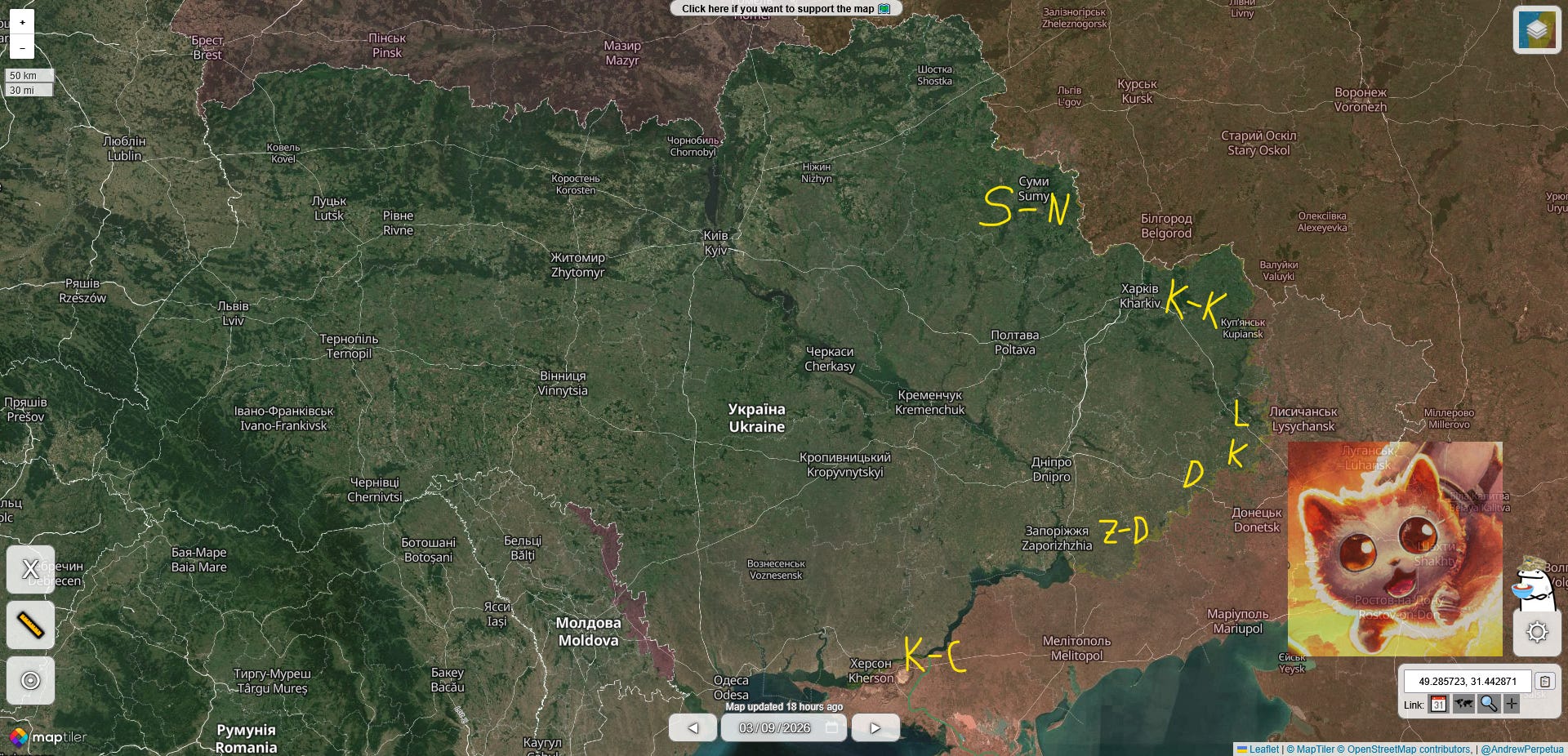
Sumy & North
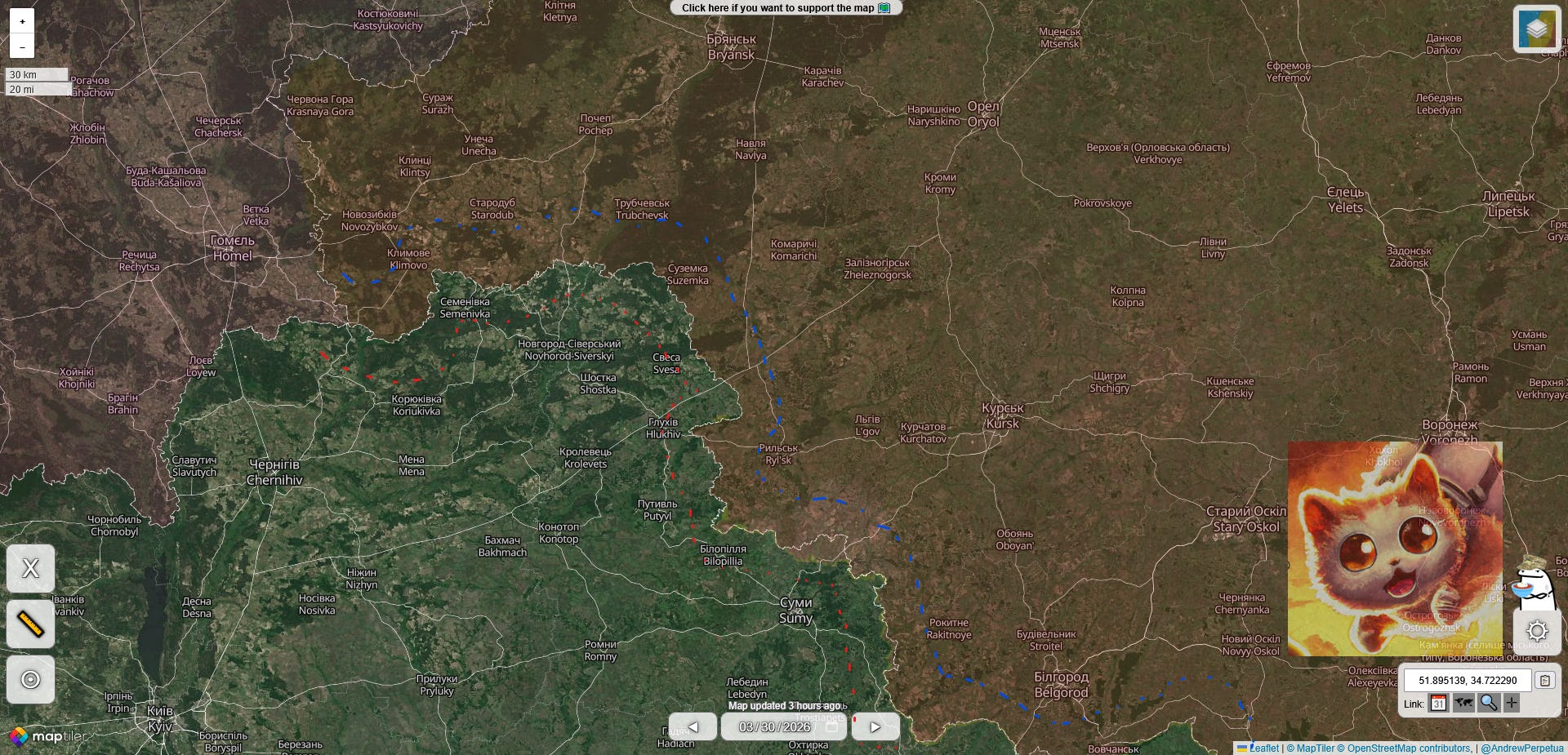
Nothing substantial has changed in the north over the past week. Still getting some orc probes in the Sumy area, but other than that both sides are trading the usual artillery and drone strikes. No indications this is likely to change.
The Kyiv-Moscow strike highway sees lots of drone and missile hunting on both sides of the border, well into each country’s interior. Bryansk has the misfortune of being right in the path. District governor would be wise to defect to Belarus. Not just him, but the whole thing. It would be much safer.
Kupiansk-Kharkiv
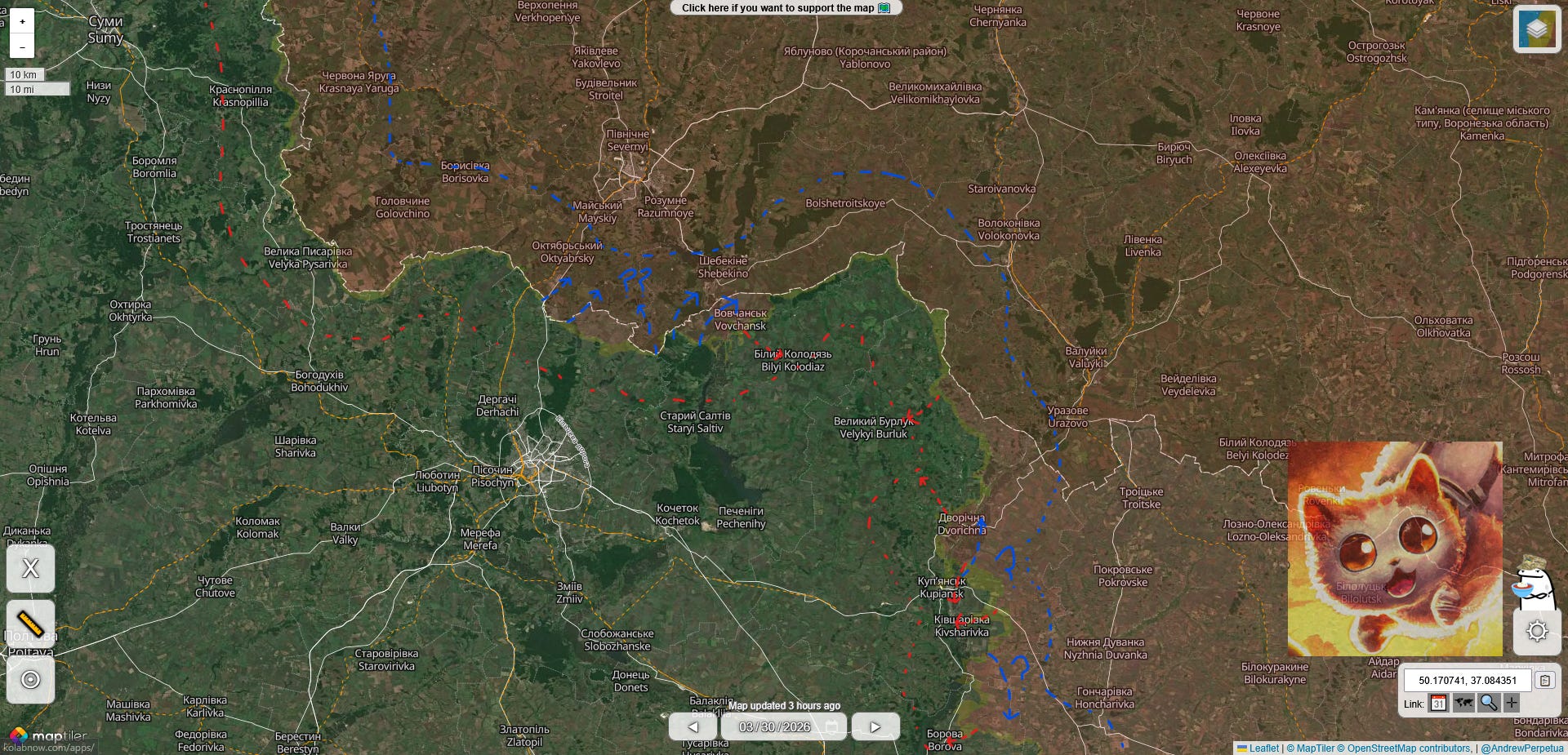
Moscow’s forces near Kharkiv get active now and again, but make little headway when they try to push south from the Vovchansk ruins. There was some orc progress in some woods between Odradne and Ambarne on the Kharkiv-Belgorod border, but nothing serious.
There’s one Muscovite grouping handling the entire arc from the border north of Kharkiv to Kupiansk, and it tends to have to switch the active axis every so often. At the moment it’s apparently Kupiansk’s turn again, with 6th army backed by parts of 1st army are again trying to reach the Oskil river and cut Ukraine’s bridgehead east of it in two.
But the effort isn’t particularly serious so far, as far as I can gather - it isn’t making much progress, at least. The Muscovite plan so far has been to advance up a continuous tree line in the Pischane area, which is more or less a frontal assault. Ukraine holds both the town and the flanks despite many infiltration and assault attempts over the past few months.
There’s a natural instability to the Kupiansk front which makes me suspect that the Ukrainians plan to do something to shore up their bridgehead here in 2026. Linking up the Kupiansk bridgehead with the one controlled by 3rd Corps around Borova seems like a straightforward goal, even if the Dvorichna bridgehead Moscow holds on the other bank is too tough to remove. Or maybe it makes too good a sink for orc reinforcements.
Lyman
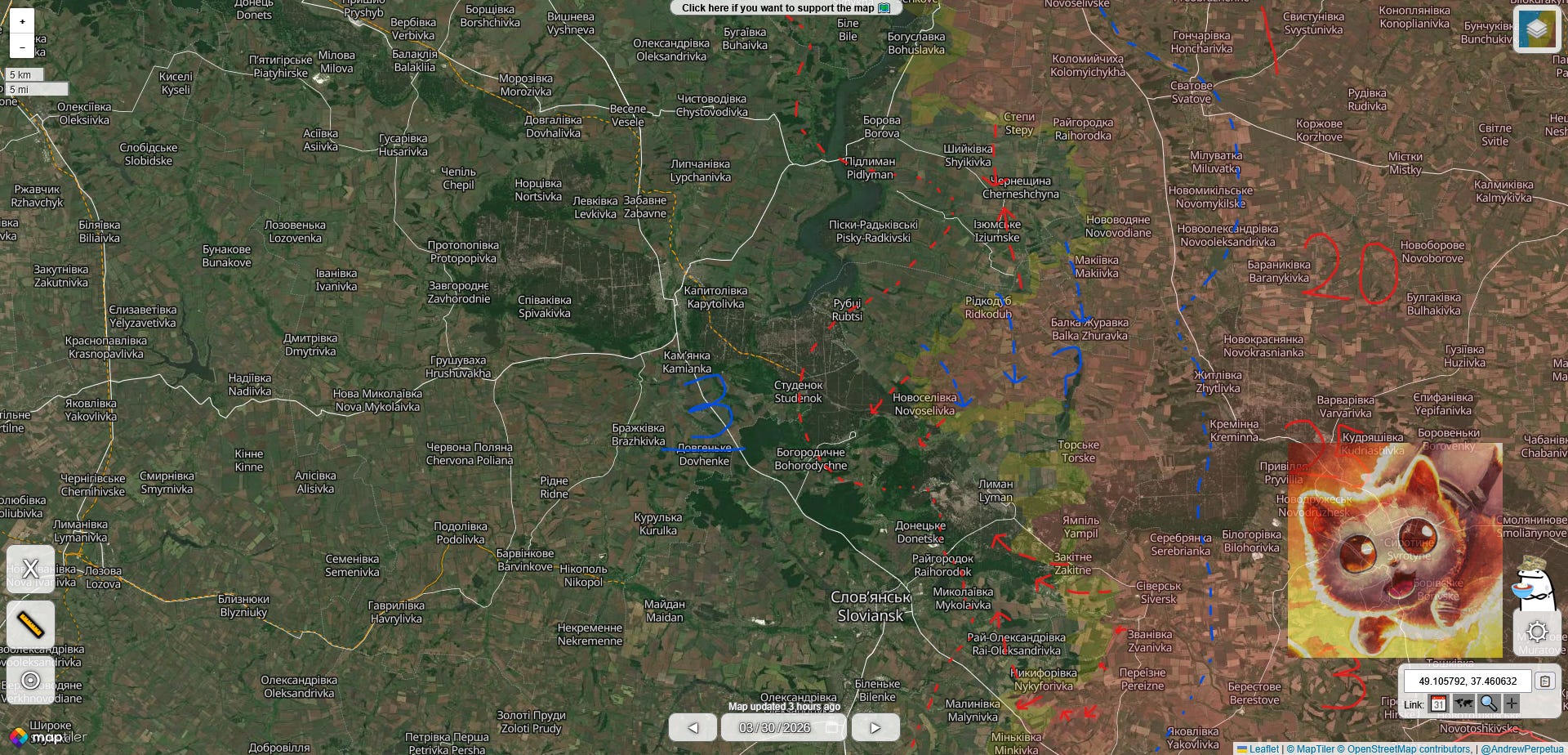
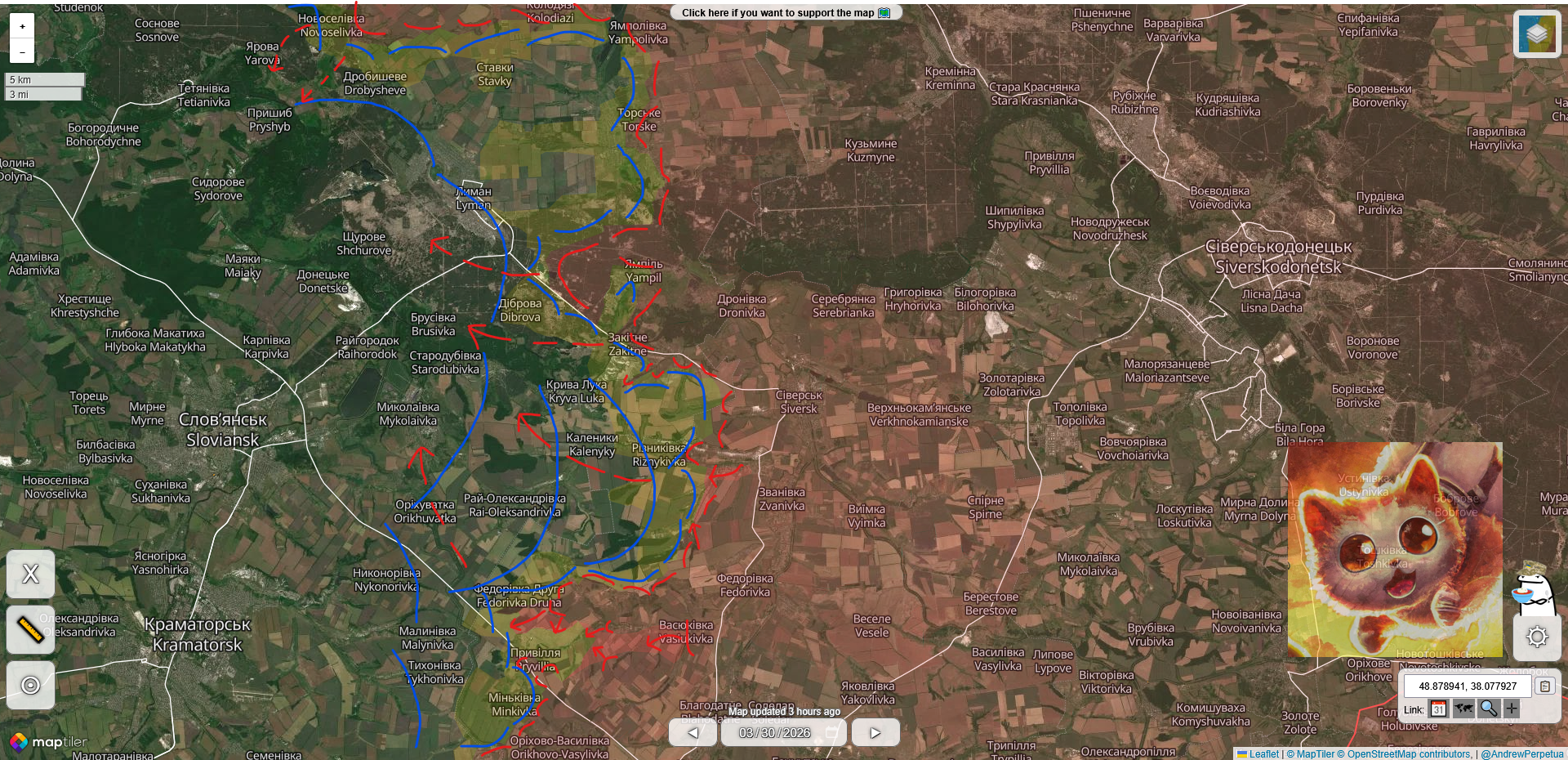
Centre for Defence Strategies has started reporting 3rd Corps as now handling the defense of the entire Lyman front, from Borova all the way down to the approaches to Sloviansk. This would be a massive chunk of real estate for one corps to handle, but if the right support structures are in place, it could be better having a single unified command covering this area.
Muscovite attacks on multiple sectors have been recorded, but gains were only registered at the southern edge of the front, where Moscow’s 3rd army is struggling to move west from Siversk. Whatever Kyiv has done with the command situation here, it seems to be working so far.
Moscow’s 20th and 25th armies were supposed to have taken Lyman and be to the edge of Sloviansk by now. Both are stalled, even with 1st army offering support from the north and 3rd the south. Right now, Moscow’s best hope is that the spring leaf-out provides enough cover to overwhelm the Ukrainians at a couple key points.
Borova covers 3rd Corps’ northern flank, and if the orcs can reach it or collapse the 3rd Corps positions that still hold a small slice of Luhansk free from Putin’s grasp, this will disrupt the so-far successful defense of Lyman’s northern approaches. Won’t be catastrophic if it happens, but would definitely make a Ukrainian counteroffensive into Luhansk a lot tougher to get going.
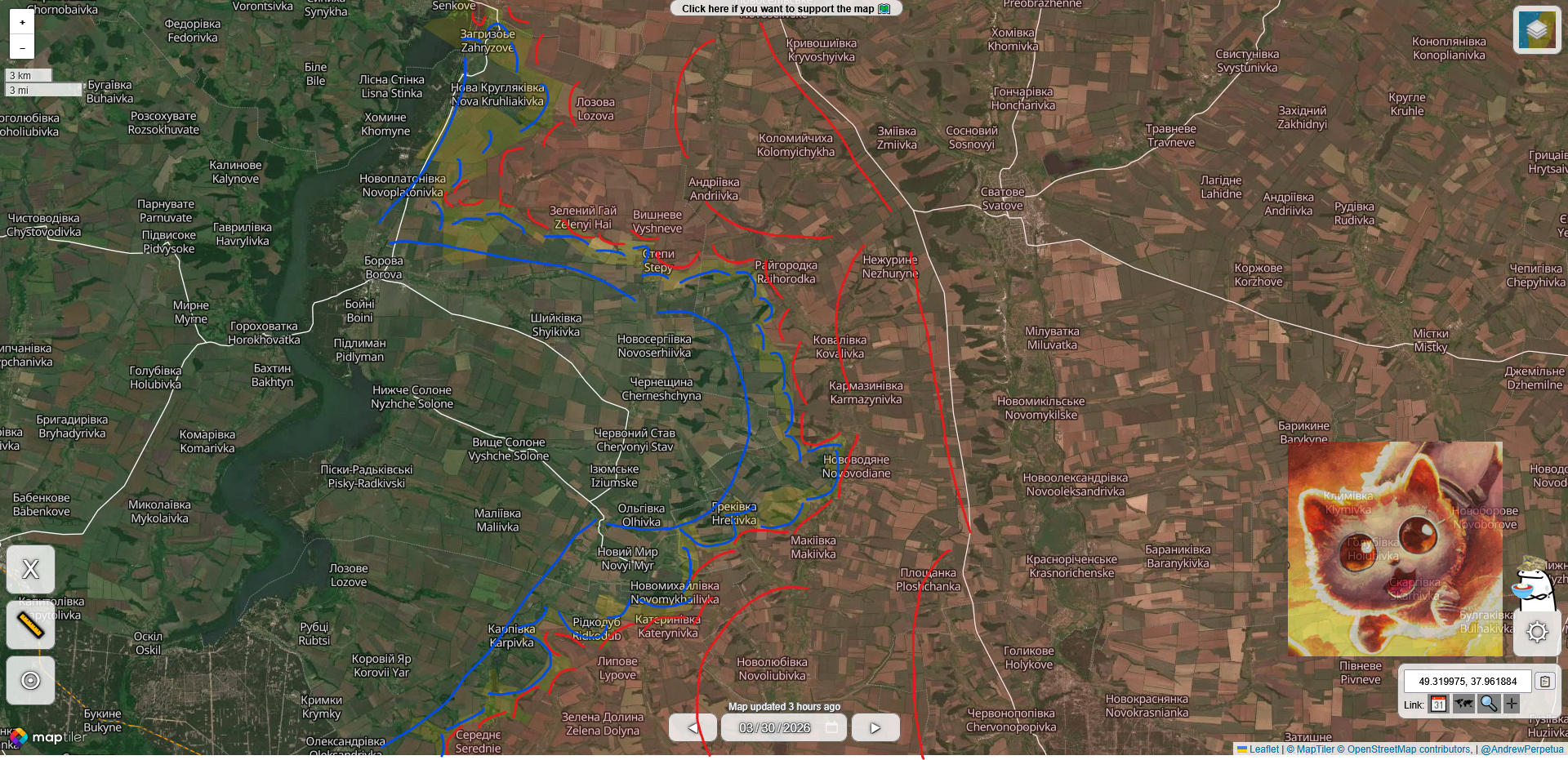
On the southern flank, the orcs are scoring a few minor gains west of Siversk, but so far remain unable to push the Ukrainians off the heights or out of the forests between Siversk and Sloviansk. Moscow probably needs another army to push down the Bakhmut-Sloviansk highway to stand any chance of swiftly overpowering the Ukrainians on this axis. Splitting 3rd army between backing 25th along the Siverskyi Donets and advancing up the Siverskyi Donets-Donbas canal is diluting orc combat power too much.
Constantly over-estimating what Putin’s forces can actually hope to achieve is one of his biggest flaws. A trait he definitely shares with Trump.
Kostiantynivka
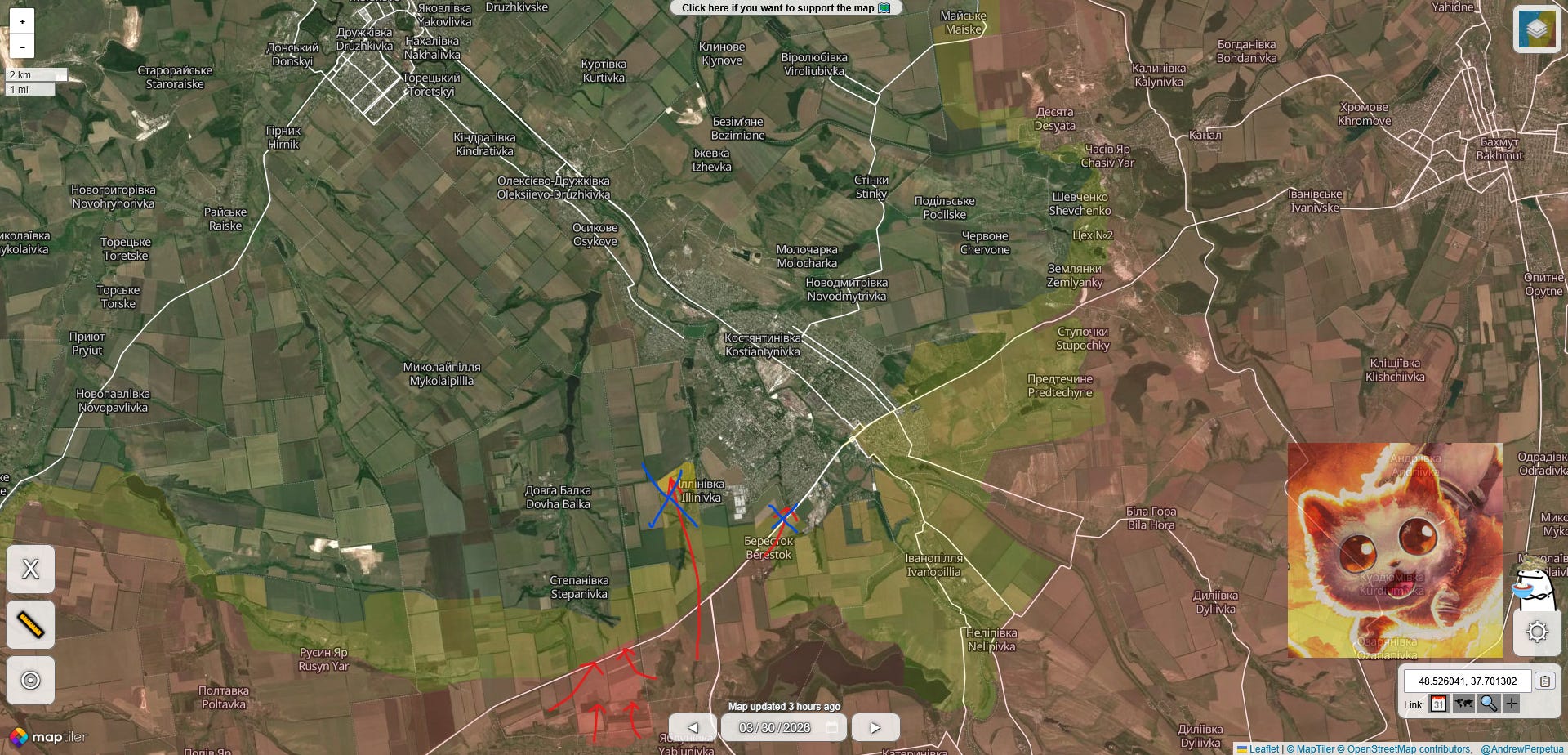
Moscow’s 3rd army getting preoccupied further north has done serious damage to Putin’s hopes of taking Kostiantynivka. Instead of an advance from Chasiv Yar to Druzhkivka that bypasses this urban fortress, Putin’s 8th army is forced to come at it head-on. After being depleted supporting 51st army’s ill-fated assault on Dobropillya.
Thanks to a combination of intense glide bomb strikes on concrete structures, mass drone attacks on logistics corridors, and relentless infiltration, sometimes the orcs manage to get a group or two into the center of downtown. There they are relentlessly hunted down, 19th Corps having run this drill countless times in Toretsk over the past year and a half.
Ukrainian forces are holding so firmly to the city that it is beginning to look as if surrounding it by reaching Druzhkivka from one if not two directions is mandatory. At least one, probably two combined arms armies are needed in addition to another pinning the Ukrainians in the urban fortress.
If this is any preview of the broader fight for urban Donbas, as I suspect it is, then Moscow’s inability to surround it with a deep flanking maneuver culminating far to the west means that Donbas simply will not fall. Ukrainian resistance is not increasing at a linear rate the closer the orcs get, but exponential. It’s like pushing two magnets of the same charge too close together. Only one is now becoming a lot stronger than the other.
Each front is intimately connected to all the others. I’ve read that Moscow’s strategy is to keep extending Ukrainian lines until they’re weak enough somewhere in the middle to fall to a gut punch. If so, the attempt is a miserable failure, and the superiority of interior lines is giving the Ukrainians another crucial edge.
As they have this on a national scale, so too is it apparent in Donbas. Ukraine can defend more efficiently the closer the enemy gets to the heart of the fortress. In a strategic sense, it’s a gigantic trap. Hence Putin being so desperate to bluff Ukraine into giving it up without a fight.
When D.C. demands that Ukraine withdraw, it is siding with Putin. Period point blank. Allies of Putin deserve to share his fate in any moral universe worth considering.
Dobropillya
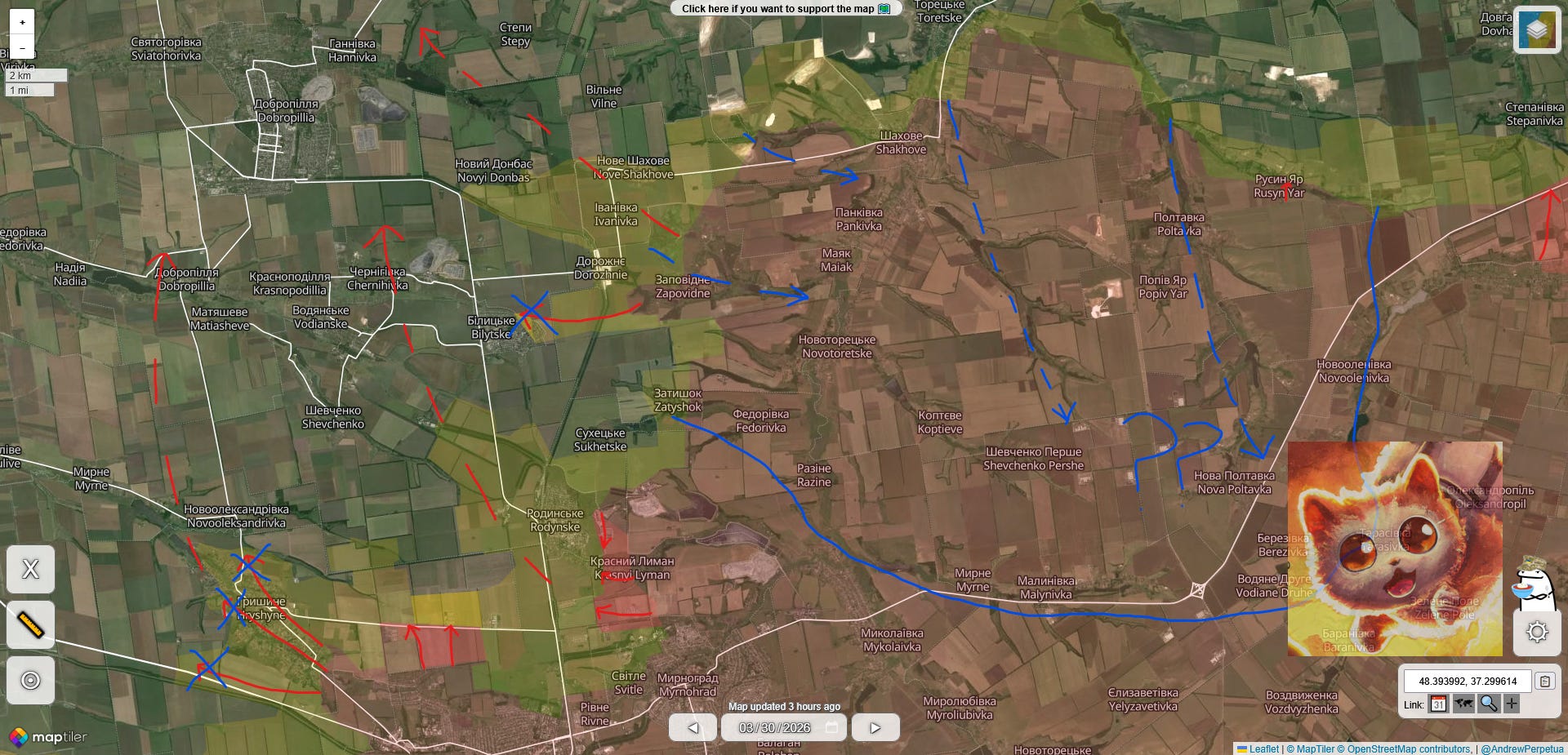
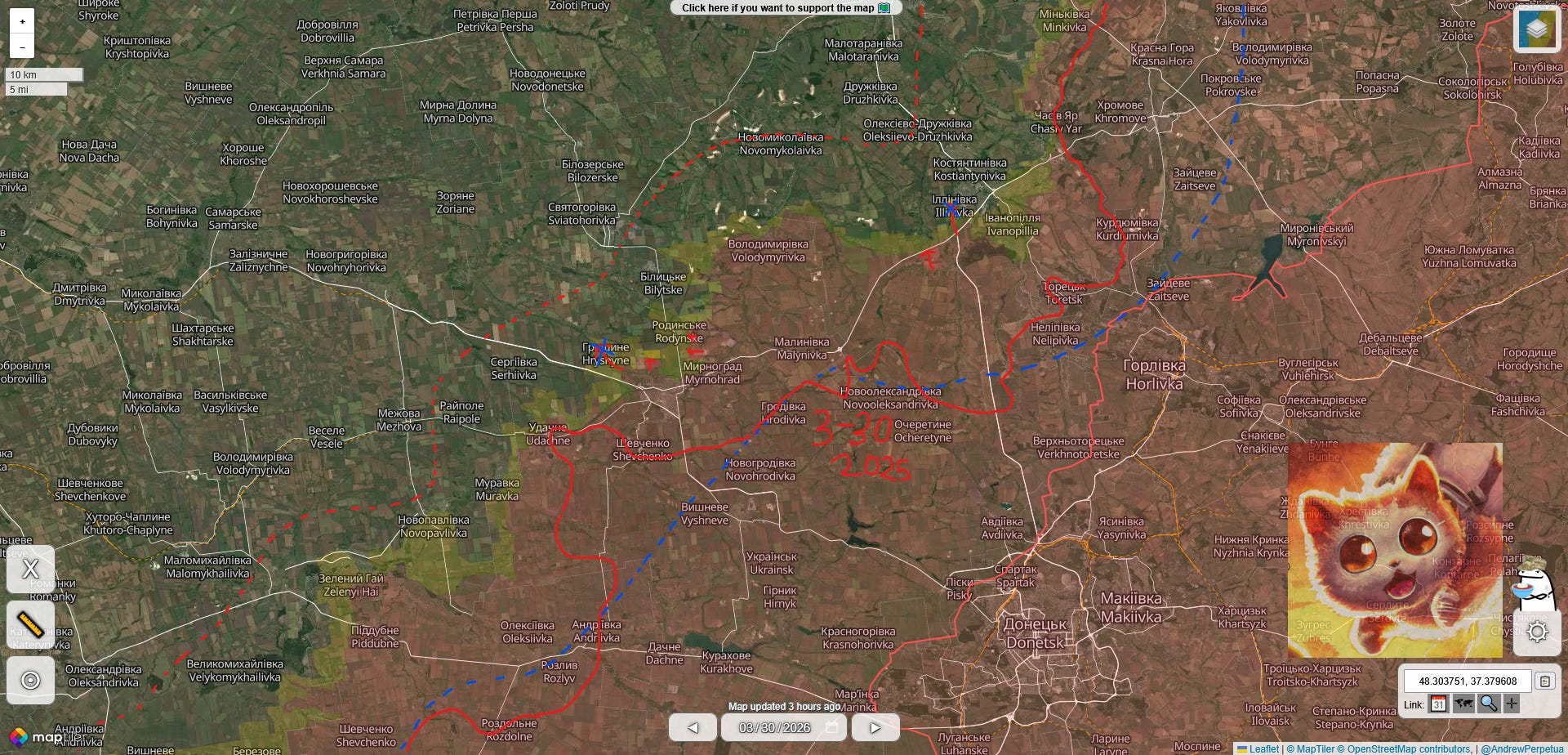
To this point, the orc inability to use the seizure of Pokrovsk and Myrnohrad for any productive purpose has been almost startling. Ukrainian sources are debating whether the neighboring village of Hryshyne has fallen or not, but this misses the bigger point: it’s the end of March, and the orcs have barely moved beyond Pokrovsk.
They are only, at long last, clearing outlying Ukrainian positions on the northern outskirts. But they’re bogged down in Hryshyne, blocked everywhere further west, and to the north along the Kazenyi Torets bridgehead Ukrainian lines are holding firm. Must help that many of the small towns in this area boast an unusual density of concrete high-rises. All that Soviet architecture was positively designed to sustain an insurgency, I swear.
At this rate, it stands to be summer before the orcs can manage to reach the edge of Dobropillya, and pushing between it and Druzhkivka looks nearly impossible. 1st Corps seems to still be covering that front, making an actual counteroffensive a real possibility. If a Ukrainian push of 15km east of the Kazenyi Torets broke through to the Pokrovsk-Kostiantynivka highway, that secures the western side of Kostiantynivka and allows Ukrainian forces to hit orcs moving west of the Kleban-Byk reservoir from the flank. Pokrovsk and Myrnohrad would face drone attacks from three directions, not just two.
A year ago, taking Pokrovsk was the best orc option for pushing west of the urban Donbas fortress belt using the last armored reserves available. Ukraine’s stubborn defense held the enemy back for so long and inflicted so many casualties that this is now extremely unlikely to ever happen. The assault on Kostiantynivka was critically weakened by the failure to secure Pokrovsk long ago, as three of Moscow’s combined arms armies were literally decimated grinding through the place.
But just as responsible for this bad situation was the campaign being hindered by Putin’s insistence on trying to stretch the Ukrainians and seize territory which will have little impact on the conflict when all is said and done. Pretty much everything Moscow did south of Pokrovsk has been a grave mistake.
Zaporizhzhia-Dnipro
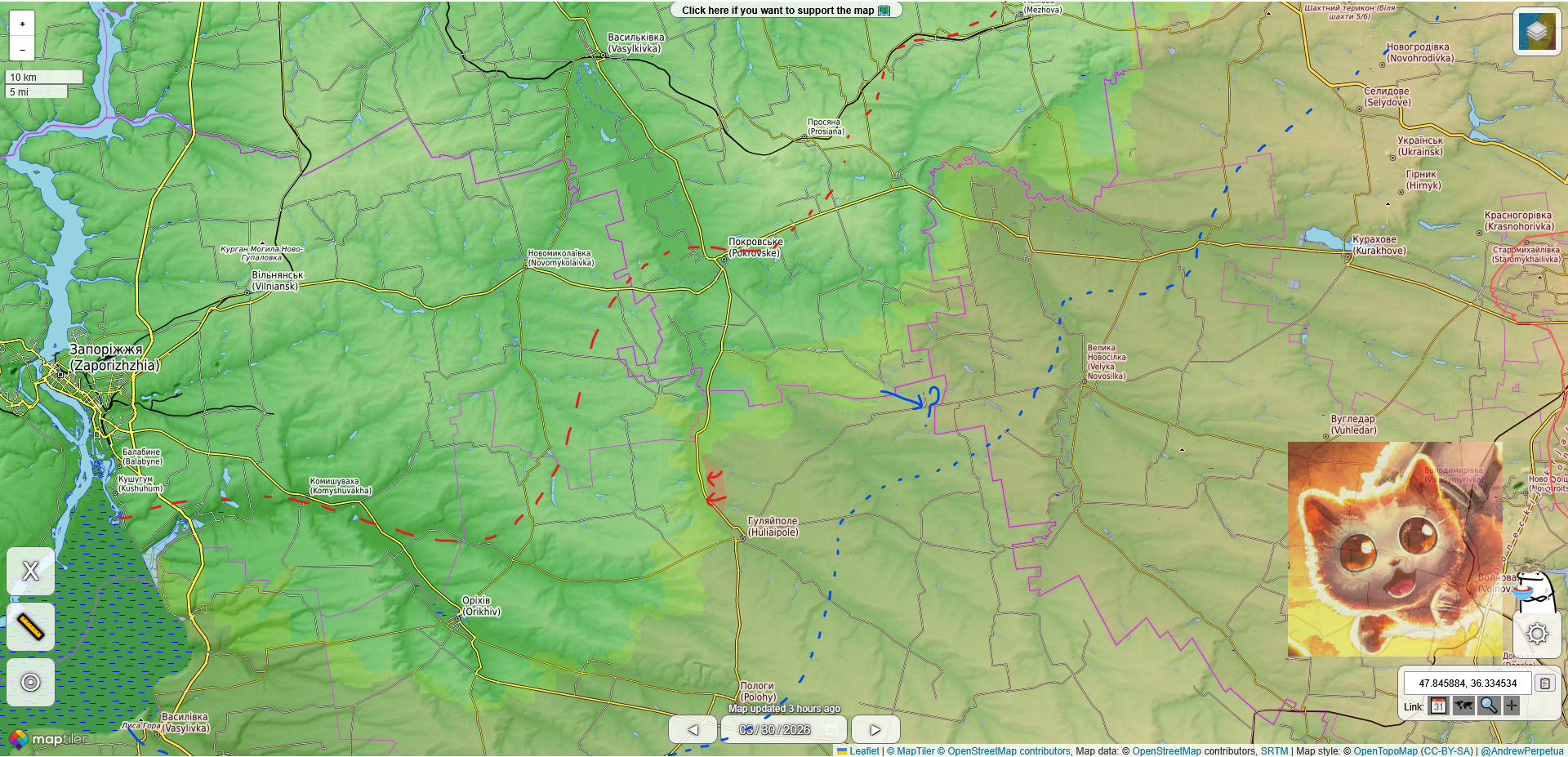
Lots of fighting in the south, as both sides press offensives almost side-by-side, but very little movement on the ground this week. The Ukrainian advance south of the Vovcha is methodical and cautious, with confirmation of territory liberated only coming after it’s been largely under Ukrainian control for a while.
Latest rumors put advance Ukrainian teams on the outskirts of Temyrivka, which sits along the Velyka Novosilka-Huliaypole highway. If the Ukrainians can reach and secure it, Uspenivka is probably bound to be liberated too. Unless orc reinforcements arrive and prove effective by summer, Huliaypole could be partly freed as well.
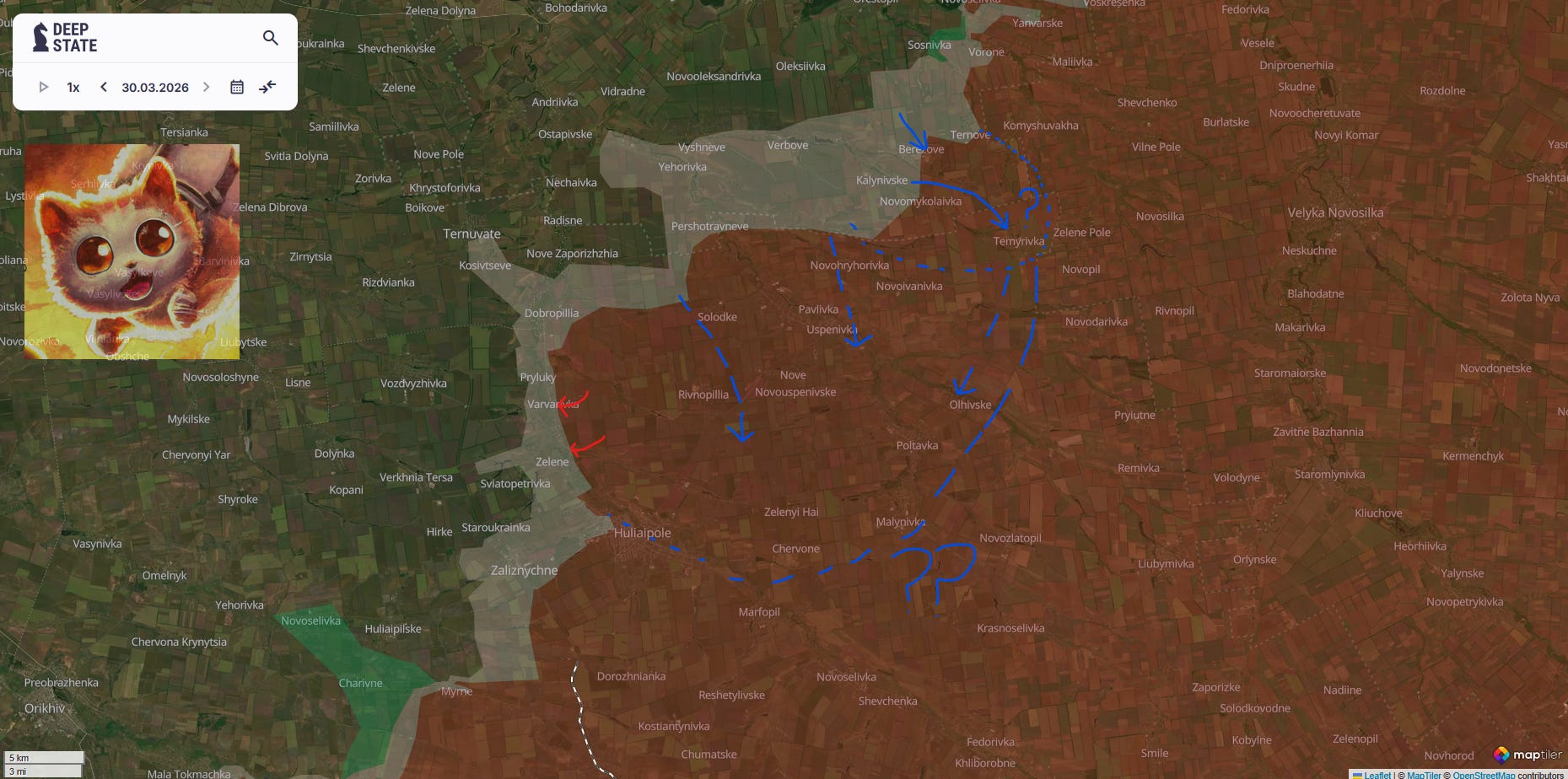
Advancing even farther is still on the table, though I suspect the wiser course of action is to try and liberate northern Huliaypole while there’s a chance of making that stick. Unless the plan is to halt fairly soon and meet the upcoming series of orc pushes where the Ukrainians now stand.
The orcs are working their way west of Huliaypole towards Orikhiv as they can and even solidifying their control over the highway to Pokrovske near the outskirts of the former. The Myrne area is very difficult for Ukrainian fighters assigned there, though a couple POWs were rescued by Ukrainian drone attacks here the other day.
Heavy fighting for Zaliznychne continues; from here the Ukrainians can support the last positions held on the edge of Huliaypole, so the orcs need to kick them out to hold the place. The space between Mala Tokmacha and Huliaipilske is of concern if reports of orc reinforcements massing here are true. 118th Mechanized seems to know its business and have the area locked down, though.
Aside from that, there’s still fighting underway in Stepnohirsk and sometimes Prymorske out along the former Dnipro reservoir, but it isn’t critical. 58th army seems intent on getting closer to Zaporizhzhia, but luck isn’t with them.
Moscow’s misguided efforts to advance across Ukraine’s south since 2025 is something of a personal victory of mine, even if I actually had zero impact whatsoever, as seems likely. But, if I did somehow manage to help Ukraine with anything during this war aside from being one additional voice calling for the Ukrainians to get more support faster, I very much hope and intend for it to be making such a huge mistake in diverting forces to this part of Ukraine instead of Donbas.
Last year, when I wrote about Ukraine’s hypothetical war-ending Volnovakha Campaign, a personal reach goal was to plant a poison seed in any russian intelligence analysis, especially anything using generative AI to pull useful information from foreign efforts like mine, that would encourage orc intelligence to worry about a Ukrainian campaign plan which was almost certainly obsolete by that point. Just a useful illustration of how an offensive could be run in theory.
I originally conceived of a campaign much like it in 2023, before the big summer counteroffensive, based on my own read of the defenses and where western gear was most suited to operate. I actually didn’t publish it back then because I suspected that the Ukrainians were actively encouraging western sources to think a single heavy thrust from Orikhiv to Melitopol through Tokmak was the plan. Didn’t want to accidentally write something viral that messed with that.
May sound like an unreasonable concern, but I’ve had stuff on prior blogs get hundreds of thousands of views. Stuff travels further than people realize, even if they never know.
Even before the 2023 counteroffensive, the Ukrainians knew full well that the Pentagon leaks like a sieve, and also that Pentagon generals steeped in counterinsurgency hadn’t the first clue about waging a war like this. Any honest one among them would freely admit that nobody really knows anything about running military operations in a total war until they’ve actually done it. Theory only gets you so far - it’s a good basis, but there will be a learning curve before the nuances of application are fully understood.
This is what makes the Ukrainians the most important source of knowledge about military affairs as they presently stand anywhere on the planet. Except russia, and to a lesser extent North Korea. Folks with stars on their chests or shoulders don’t seem to like this truth, though.
Once the 2023 counteroffensive got underway, I claimed, and continue to hold, that the actual plan was for the Orikhiv and Velyka Novosilka branches of the counteroffensive to converge south of Polohy, not strike through the heaviest orc defenses built on the obvious route through Tokmak. No competent general would ever launch a blind frontal assault like that - only a NATO committee would try something so naive.
The real cause of the counteroffensive’s failure to live up to expectations was simple timing: Ukraine originally wanted to go for it in 2022 and in retrospect should have, as the plan the Pentagon preferred - a slog through dense orc defenses and elite troops in Kherson - only worked in the end because of the shocking push the Ukrainians managed in Kharkiv. Nothing the Ukrainians could have achieved with the limited numbers of modern armored vehicles made available would have ended the war in 2023. Lacking proper air support, even unlimited tank and IFV supplies might not have been enough.
There wasn’t much point in setting the public record straight on the real Ukrainian plan. Even after the offensive began in 2023, I didn’t ever fully articulate exactly what a strike to cut the rail line along the Azov highlands would have to look like. Just in case an opportunity presented itself in 2024.
By early 2025, however, I was pretty sure that the Ukrainians wouldn’t go down the path of a classic counteroffensive over such open ground, and figured that even if they actually did, anything I might do to highlight the possibility wouldn’t do Moscow any good even if orc intel latched on. A rule I now follow when writing about a possible Ukrainian push in Luhansk this year, as well. Even if someone is listening over there, it’ll be lack of reserves that does the orcs in now. Same as in 2022.
Last year, on the off chance that somehow any orcs were gleaning anything useful from my work, I decided to lay out a plan that I judged the Kremlin would be secretly worried about but that the Ukrainians probably wouldn’t go for at this point. Again, no evidence whatsoever that I had any impact, but I’ve still been fascinated to see the orcs dedicate three full combined arms armies and the better part of two more to advancing between Huliaypole and the Vovcha river, right about where Ukrainian forces would need to concentrate before a drive to Volnovakha.
This mistaken commitment has brought large territorial gains in a place where these no longer strictly mattered. Ukraine isn’t about to negotiate an end to the conflict that ceded Donbas just because Moscow pushed artillery within range of Zaporizhzhia. It’s flat-out impossible for Putin’s depleted military to push deep into Ukraine and bypass Donbas far to the west at this stage of the war, so of all the places the Ukrainians could afford to trade space for time, this open steppe was it.
What could the forces allocated to this area have achieved in Pokrovsk, Kostiantynivka, or Lyman? Until counteroffensive operations began a few weeks ago, the Ukrainians had only two of their eighteen corps assigned to this area and an even smaller proportion of their best brigades. Proportionally, the Ukrainians invested far less in defending this area than Moscow put into taking it. This was another very poor strategic choice on Putin’s part.
Kherson-Crimea
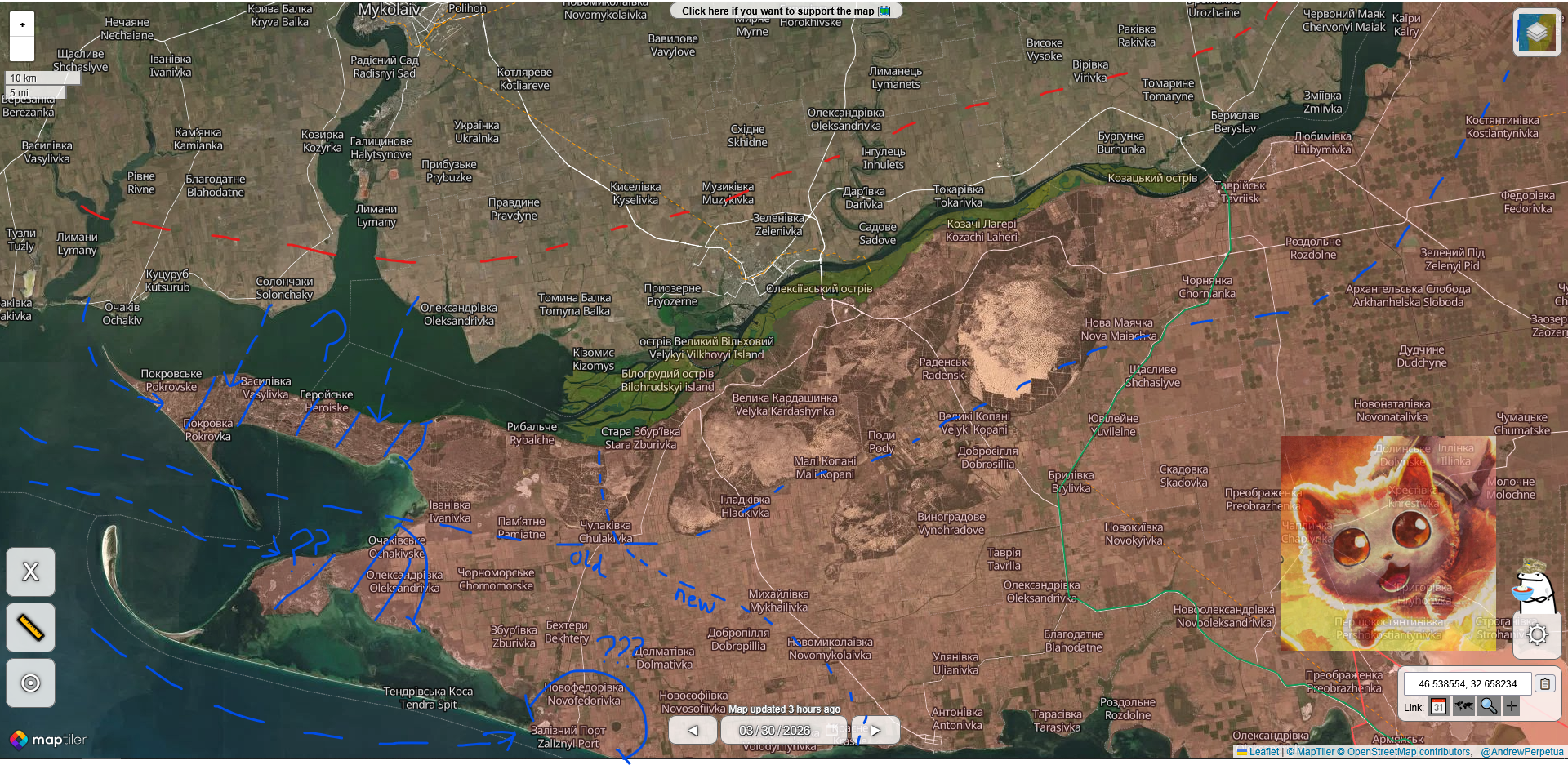
Moscow’s inability to grasp the battlefield reality of this conflict makes me suspect that some Ukrainian amphibious operations are possible by the end of this year. Supposedly, the British military was a big proponent of what turned out to be an inadequately planned and supported assault across the Dnipro in late 2023.
While the crossing bogged down and degenerated into a costly Ukrainian bid to hold a small bridgehead for much too long, what some hoped would be Ukraine’s D-Day might end up being its Dieppe. In the Second World War, long before the landings at Normandy the British tried a lesser amphibious assault at the French town of Dieppe that went wrong, with a lot of Canadians basically sacrificed. Yet it taught the Allies a lot about the operational demands of a cross-channel operation that paid dividends in 1944.
Maybe I’m very wrong about the British mentality when it comes to such things, but I seriously doubt that anyone involved ever gave up on the possibility of getting across the Dnipro, or even reaching Crimea. Drones may make this possible. We’re talking very small numbers, but it could now be feasible for even a few dozen specially trained infiltrators to lock down a port or peninsula. Just enough to make it brutally costly to repel them, but not so many that they can’t be quickly pulled out.
With the Ukrainians on the cusp of parity in the skies over the western Black Sea, possibilities are worth considering. The orcs should be worried, at least.
Strike Campaigns
Not much came of that big, record-setting orc drone wave last week. Lots of scattered damage to mostly civilian stuff and a few fatalities, sure, but not enough to impact the course of the war, just rack up a few more atrocities.
Though a tactic the orcs have been testing for a while but look to be leveling up in a big way is remote mining using Shaheds. There’s footage now of a Shahed dropping small explosives, and by design attacks like these are totally indiscriminate. More of an incentive to get drone interceptors working close to the border.
Moscow’s missile strikes are less frequent and intense at the moment, so in all likelihood another big wave of attacks is being planned. Though the spring push has begun - or if you like, the winter push just bled over, as it seems to go in this war - it’s still in that early phase where the orcs like to initiate combat with a wave of assaults then sit back and blow stuff up for a couple weeks while prepping the next group of disposables. Their main task is to locate Ukrainian positions for these to be pounded - that’s it, that’s all.
Between waves, Putin’s generals usually up their use of missiles in attacks on operational targets like presumed headquarters and any kind of gathering of Ukrainian forces. Another reason to expect an amplification of orc attacks sometime in mid to late April.
The Ukrainians, well, they’re killing it out there. Literally. Moscow’s main export terminals on the Baltic Sea burned for days this past week, smoke visible from Estonia and Finland. Satellite shots after the blaze finally went out show multiple shattered tanks. This was not the only strike on oil stuff, just the most notable. Refineries got whacked again too. And more industrial plants.
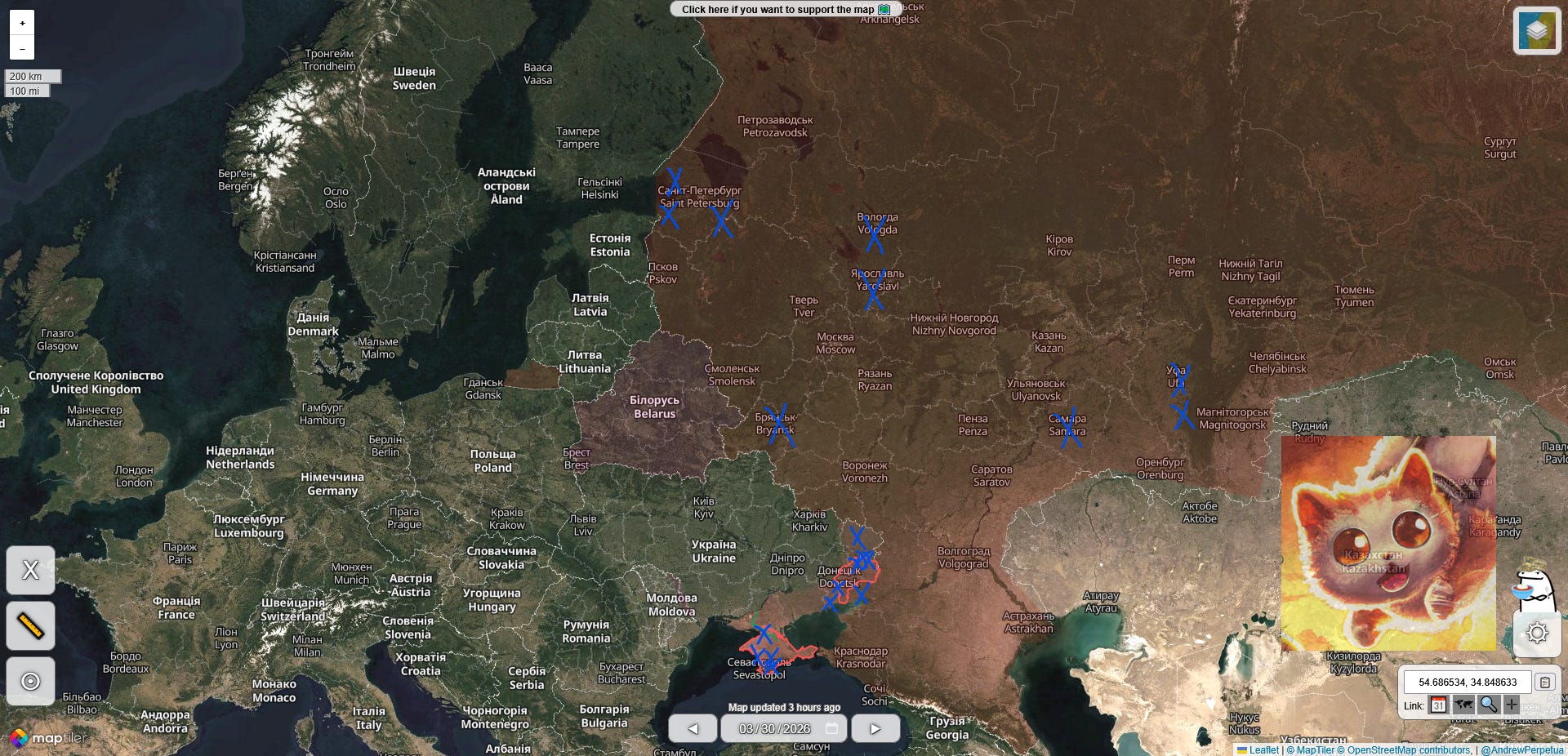
Operational level attacks continue to gain strength, with air defenses getting torn apart day after day. Thank goodness Ukrainian drones are better than Iranian, or the Iran War would be even more of a nightmare.
Whether coincidental or a direct function of trying to minimize Putin’s windfall profits from oil sales, the renewed Ukrainian Oil Campaign has knocked forty percent of Muscovite export capacity offline, per Reuters. Double your revenues and halve your volume, and your windfall suddenly isn’t.
Rate of repair is pretty much always underestimated and nearly never acknowledged as the major variable it is, but as with specialized gear in a refinery damaged fuel reservoirs can’t be quickly replaced. The pain will linger, and nothing says the Ukrainians won’t inflict a whole lot more yet.
Multiple strikes by drones on the same area over multiple days a good thousand kilometers from launch points in Ukraine in what should be one of the most heavily parts of the empire is a dangerous sign for Putin. That longtime loyalists who supported his sick “special military operation” have begun turning on him and voicing public disgust is almost as bad.
Ukrainian forces identified or tore a hole in enemy air defenses that exposed the empire’s second city and most important port, and the enemy couldn’t plug it for half a week. If I’m playing this simulation from the russian side, this is the moment where I go oh, shit.
To my knowledge, the Ukrainians didn’t use their Flamingo missiles in this attack. Three were deployed against a chemical plant in Samara, also a thousand klicks beyond the Ukrainian border. One was shot down, two others fell adjacent to, but not on, likely target structures. However, if this trio had landed on a tank farm, a near-miss would have been good enough.
The Ukrainians still aren’t even at their peak capacity when it comes to hitting stuff inside russia. Anything in occupied Ukraine is pretty much screwed. I get the distinct sense that an arc from Mariupol to Millerovo centered on Rostov-on-Don is guarded by a pretty dense orc air defense network, second in strength only to the one around Kerch Strait. Ukraine has worked out how to punch corridors that route around these nodes to get at southwestern russia, while a barrier line between Volgagrad and Bryansk is slowly becoming more porous.
Inability to block Ukrainian weapons soon after they cross the border creates a nearly impossible problem for Moscow. Moscow itself doesn’t even have to be targeted most of the time to have an important impact. By flying hundreds of drones nearby now and again, airports repeatedly stop working and air defenses have to stay deployed around the city. Ukrainian drones that just fly around are often missed entirely. Drones and missiles can hug river channels like robotic vikings, converging on point defenses from multiple directions.
I have not been writing for the past few years that the Muscovites should, scientifically speaking, cut and run as soon as possible, because I’m an idealist who can’t imagine a world where Ukraine loses because Sean Penn visits it instead of the boring-ass Oscars. But evidence keeps on lining up suggesting that a historic process is underway: the final fall of what is hopefully the last Muscovite empire.
It’s kind of like observing Haley’s Comet: the recurrence cycle of imperial collapse in the world system generally means that you only get to witness one burn itself down in your lifetime, maybe two. Looks like it’s Moscow’s time. Probably D.C.’s too. Winners of the last grand crash usually wind up losers next time around.
Air, Sea & Signals
Air
Still limited news on the traditional air power front. One interview I ran across with an experienced Swedish pilot suggested that Gripen familiarization for a pilot already used to F-16s or a similar modern jet will take about six months. A pilot with only basic flight training could be ready for a restricted mission set, like ambushing Sukhois, in a year.
Which tells me that, given the formal decision to acquire Gripens late last year, Ukrainian deployment of at least a flight of four to six by June is absolutely conceivable. Though some top pilots will have to be pulled from flight duty to complete training, it’s well worth it to get Meteor missiles in the fight. Aviation attrition is the last major domain where Ukraine needs to start sticking it to the orcs to completely demolish the occupation.
Aside from the Gripen wait, there’s not much new to cover with respect to the fight for Ukraine’s skies. Security partnerships with Gulf countries could net Ukraine some more older Patriot PAC-2 missiles designed to hit aircraft and cruise missiles, since the latter are covered by aircraft launched weapons and Ukrainian interceptor drones can handle Shaheds. Additional radars and launchers would be welcome, and there are a lot in the region. While the Iran War may drag out for months in some form, the phase where large numbers of missiles are fired does have a time limit of eight to twelve weeks, even if the IRGC is digging out blocked tunnels to rebuild inventories after.
Ukraine’s forced attention to covering the lower sky over the past few years is a real blessing to the world right now. Nobody else seems to have taken the Shahed threat seriously; the entire western national security establishment is paying the price now. When a combined drone and missile strike can knock out E-3 AWACS and KC-135 tankers at a major airbase used by US forces in Saudi Arabia a month into the Iran War, there’s a problem.
Drones provide enough distributed mass to overwhelm defenses, allowing missiles to slip through - especially when drones knock out expensive radars. THAAD, for all its proven ability to knock down missiles, requires a pretty massive radar that inexpensive drones will come after in force. Funny how nobody at the Pentagon seemed to think it necessary to take account of developments in Ukraine long before now, considering that Shaheds wound up hitting Ukraine thanks to Iran.
Well, the whole world is learning the hard way now what a mistake it was not to pay closer attention to Ukraine. Or end Putin’s war on Ukraine before the world system spiraled to this point. That would have been nice.
Sea
A few shadow fleet intercepts by European naval forces every week seems to be the new norm; better than nothing, the volume still isn’t what it needs to be. But hey, if the Ukrainians keep hitting export terminals, the tankers themselves will be kind of pointless.
Though they serve as spy platforms, so deserve to be carefully monitored by drones themselves. Which European countries will want to buy from Ukraine. Seems only fair, considering how the Ukrainians have taught Europe how to neutralize Putin’s fleets without even having to track them at sea.
Magura drones already go 800km. Double that is totally feasible. Drones launched from a base in the Norwegian town with the epic name Hammerfest are only 500km by sea from Murmansk and roughly 1,200km from Arkhangelsk and Severodvinsk. Those are the key Muscovite ports along the Arctic that support the North Sea Fleet. The thing can be strangled at the outset of any conflict by large numbers of drones, leaving only the elements at sea free to fight for a few weeks until they exhaust their supplies.
Vladivostok is less than 1,000km from much of Japan’s west coast. Shanghai is only 800km from Japan’s southern coast and less than 600km from South Korea. The littorals will soon belong to drones. A country like India, with its geographic position, would do well to minimize investment in large expensive fleet assets and leverage Ukrainian-style drones.
Traditional naval vessels are still useful in a blue water context, far from shores. But both air and naval drones will likely soon be launched from carrier type vessels at the heart of battle groups that use them as their outer layer of defense and primary strike asset. Battles between these groups will be a systematic contest between drones and missiles in various categories, until magazine exhaustion forces one side or both to withdraw. Needless to say, the Trump-backed “battleship” idea is doomed in this world.
Signals
Muscovite flailing in the signals domain is increasingly as evident as the inability to operate effectively on the ground. The Ukrainians long ago became adept at tracking and attacking orc communications infrastructure, which provoked the reliance on stolen Starlink terminals to begin with. Now that this option is foreclosed, old challenges are emerging anew.
What is very interesting about the orc command system is that one grouping of forces or combined arms army working under it can experience radically varying conditions. Some are more dependent on hillbilly solutions and improvisation than others. Whether Moscow knows how much deviation there really is remains a very open question.
On the domestic side, it is intriguing to see the lengths to which the Muscovites are going to restrict communications. They really, really want to push users onto the state system despite concerns about Ukrainian hackers gaining access. Children’s TV shows extolling the virtues of losing screen time is the sort of move which suggests an urgent need to prevent the real news from spreading.
Incidentally, the same impulse is behind banning kids from using social media in other countries. Once it was the internet as a whole, before that naughty TV, and before it there was adult magazines. There will always be something that someone decides to use to protect children from things the next generation will take for granted. As it probably should be. The only constant is change anyway.
Anyway, critical indicator here is the obvious fear among the orcs of ordinary people talking too much. With drones hitting multiple places in russia nearly every night, it could be Putin’s fear of his subjects sharing concerns about the disintegrating shield that once safeguarded them from the consequences of not overthrowing their stupid government. Could also be that the authorities are aware of economic problems about to get out of control despite the oil windfall of late and aiming to tamp down on people’s ability to protest.
Staff Affairs
According to an interview Syrskyi gave to a Ukrainian outlet, the plan for the year is a defensive strategic operation that sets the stage for a broader counteroffensive. Which based on the guy’s record is his way of confirming that the plan is to break the incoming orc wave and push right back.
The chief limiting variable in what the Ukrainians - or orcs - can accomplish right now seems to be drone operators. Who can organize more in a given area tends to hold the initiative.
Moscow’s Rubikon organization is busy spawning teams, and where trained and equipped orc drone operators appear the life of Ukrainian fighters gets harder. But for the most part, they rarely gain outright superiority, and after their appearance in prior battles the Ukrainians began hunting them. The average quality of Ukrainian operators tends to be higher, though, with the orcs tending to rely on sending lots and lots of simpler drones in even if fewer do anything.
Over time, it’s to be expected that Ukrainian skill on average will increase at a faster rate. Very similar dynamic at play here to the one between Allied and German or Japanese pilots during the last world war. Allied pilots got more training, leading to higher survival rates, which wound up creating a positive feedback loop that made life increasingly hazardous for weaker opponents. Later in the war ground troops were affected as well, though here the disparity outed more at the operational level.
There will come a point where Moscow’s drone teams get attacked as soon as they deploy. If the density of drones goes high enough, activity in the affected area becomes impossible.
Leaders who can understand the hard math of things are bound to perform better in the Network Age. First innovate, then get efficient. But always be ready to dump a failed approach and try something new.
Geopolitical Theater
I think Iran was covered well enough in this month’s Earth Forces Bulletin, so no need to dive too deep into that. Suffice to say that Trump is unlikely to do the smart thing and bail now, instead making the traditional mistake of getting sucked deeper into the biggest loser of a war since at least 2003. Maybe ever.
More likely is some degree of ground involvement that leads to more US casualties, prompting even more vicious bombing raids. At this point the US is happy with Israel’s most desired outcome of a fragmented Iran. The biggest surprise from the standpoint of the conventional wisdom would be a focus on the Baloch-majority region of Iran adjacent to Pakistan.
You’d think it’d be beyond crazy to connect the Iran War to instability in Southeast Asia, but here’s where Saudi Arabia and the UAE factor in. Both are staring at a future where they’d prefer to swap out an unpredictable USA that will always prioritize Israel over them with China as a security guarantor. Chinese influence can be balanced by the ring of countries around it that all also need Gulf oil and gas.
The only way to really keep Iran under control is to have China fully invested in preventing conflicts between its suppliers. So for the UAE and Saudis, if the USA can be convinced to partially dismember Iran, great. If they wind up administering territory along Hormuz, the IRGC can never leverage the threat of closure against them, and they’ll have their very own replica of the Houthis in northern Yemen to threaten Tehran with.
Pushing Trump to send troops into Iran would open the door the Saudis and Emirates to accomplish what they never could: a breaching operation. As Iran has launched numerous attacks against Saudi Arabia, which has a mutual defense pact with Pakistan, it’s not inconceivable that Islamabad will tolerate supply shipments and even the movement of Balochi insurgents it might otherwise be fighting itself across its border. Only so much Iran can do other than complain, since Pakistan is a nuclear power.
Anything that keeps Pakistan occupied with something other than getting into spats with India is probably seen as a net gain in many area capitols. So long as India doesn’t get any ideas about hitting the Pakistanis while their back is turned.
A wild card in the Southwest Asia geopolitical morass of it all is the conflict between Pakistan and the Taliban. What might the Taliban get up to in all of this? A whole series of really unpleasant dominoes can all too easily fall thanks to the Iran War. Not so much leading to an immediate open war, but definitely sowing the seeds for some in a few years.
China, of course, is sitting back and watching this Middle East war play out with a mix of bemusement and amazement. There’s a meme going around in China that suggests Beijing is winning by literally doing nothing at all. An exaggeration, of course, but not entirely so. China is dangerous because China is both methodical and opportunistic. American leaders are the exact people to forget that it’s exceptionally unwise to fight someone smarter than yourself.
The Chinese are getting an instruction manual in how to disrupt US military plans out of the Iran War, while US inventories of stuff Ukraine couldn’t have because of the potential for a fight in the western Pacific get burned through in the Middle East. As the dependence of most countries on tight global supply chains that mostly run through China is the Achilles heel of western power, Beijing will eagerly note the power Tehran is exerting over Hormuz.
Everything Iran can do to the US by messing with markets, China can inflict ten or even a hundred times over. That’s leverage. Now add in China’s ability to throw a lot of missiles and drones at US defenses depleted by the Iran War and impossible to replenish for several years. The odds of China making a big move by next year are extremely high.
Unless, of course, the western experts have China all wrong. Best hope that the Chinese are more risk averse than feared and smart enough to see the Taiwan issue as best left forever unsolved because it can always be exploited for domestic and international gain - but only if free. Otherwise, barring radical adoption of Ukrainian methods and technology, watch out, free world.
Though worldwide depletion of ballistic missile interceptors is not good for Ukraine, closer connections to the Gulf and anybody else worried about coping with thousands of strike drones will benefit both sides. More Patriot radars, launchers, and PAC-2 missiles could do excellent work against orc jets straying too close to Ukrainian airspace. Additional protection against cruise missiles on certain vectors would let Ukrainian F-16 pilots get more Shaheds. Every added bit of capacity helps in a war like Ukraine’s.
Beyond, it is to be hoped that Ukrainian companies and the government can fully capitalize on being well ahead of everybody else on most aspects of Network Age warfare. Starting to wonder if there are any Ukrainian drone firms out there who could use a remote English-speaking writer-analyst. This gonna be a serious growth industry.
Conclusion
It may sound strange, given the many horrors of the Ukraine War, but I can’t help but find a fair few reasons for optimism about the future because of the way Ukrainians have risen to the occasion. They didn’t ask for this, nobody would, but instead of giving up and submitting millions have been willing to endure hell. Can’t but wonder how many other countries would stand after what Ukraine has endured.
The USA has never been through a baptism of fire anything like it. Not even the Civil War, which killed off a large proportion of the population, including a couple ancestors of mine. I am 100% convinced that were Putin to threaten to nuke D.C. if Trump didn’t hand over Alaska and probably Hawai’i too, the USA would go back to 48 states.
Ukrainian grit and resolve stands to carry the country through this war yet. That and the adaptive capacity to recognize and invest in the potential for mass drone use. US forces in Iran had better hope the IRGC didn’t learn from the Ukraine War. But in military affairs, experience is the best teacher.
Very possibly the only one. Yikes. Guess that’s another point in favor of education through simulation.